

Here is the full English translation of your comprehensive guide on technical interview preparation.
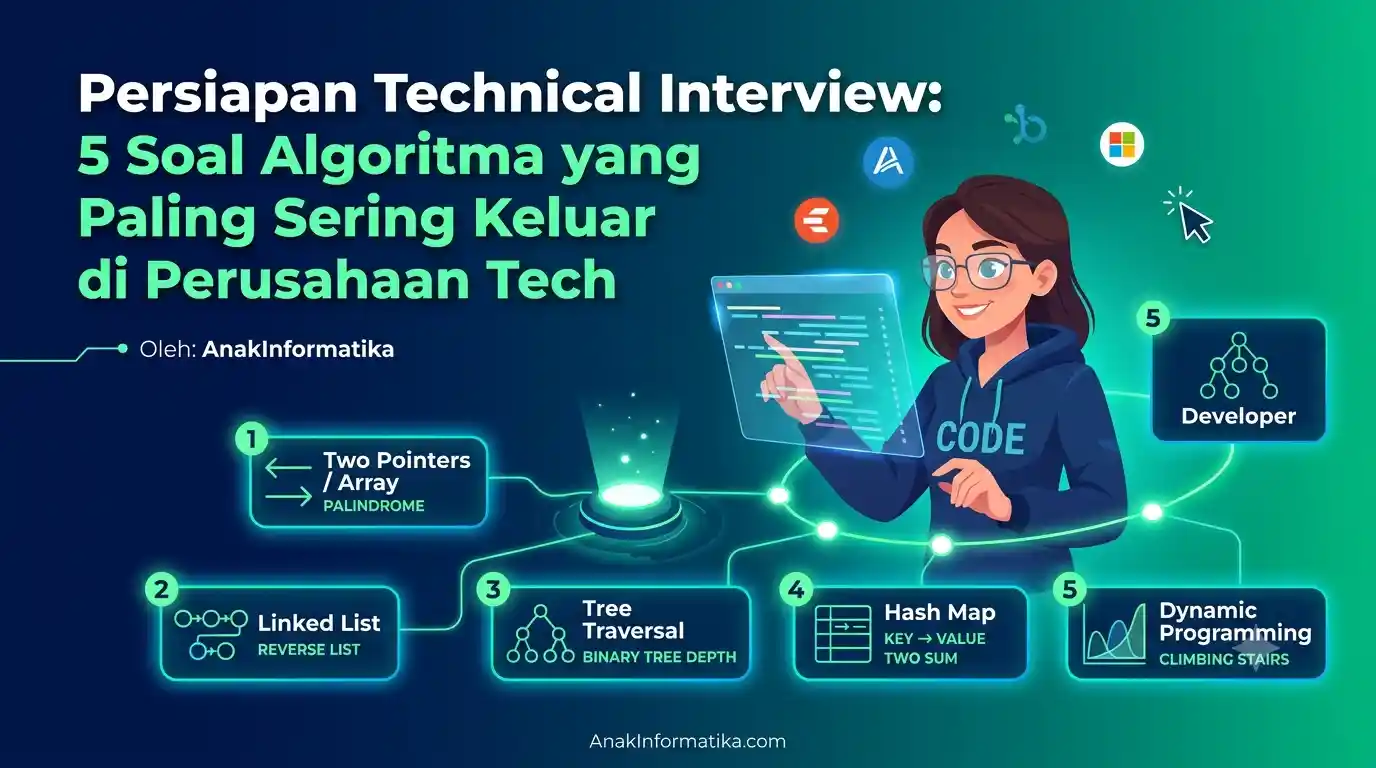
Technical Interview Preparation: The 5 Most Frequent Algorithm Questions at Top Tech Companies
Hey there, Tech Enthusiasts! Who here dreams of working at big tech companies like Google, Amazon, Meta (Facebook), or other unicorn startups? Probably many of you! With the tech industry rapidly evolving, the competition is getting fiercer than ever. One of the most crucial stages that often makes aspiring developers break out in a cold sweat is the technical interview—specifically the session testing your knowledge of algorithms and data structures.
To help you feel more prepared and confident, we are breaking down the 5 Most Frequent Algorithm Questions Asked at Tech Companies. This isn't just a list of problems; we’ll unpack the core concepts behind them, explain why they are so popular, and show you the high-level logic needed to solve them. Let's dive in!
1. Array & String Manipulation (Two Pointers / Sliding Window)
Questions involving arrays or strings are the "bread and butter" of technical interviews. They appear frequently because arrays and strings are fundamental data structures widely used in real-world applications. One of the most powerful techniques to solve these efficiently is Two Pointers or Sliding Window.
-
Core Concept: The Two Pointers technique involves using two pointers (or indices) that move through an array or string—often from opposite directions (one from the start, one from the end) or in the same direction at different speeds. The goal is to reduce time complexity from $\mathcal{O}(N^2)$ to $\mathcal{O}(N)$.
-
Why It's Asked: It tests your understanding of efficient iteration, handling edge cases, and your ability to optimize solutions to save time and memory.
ℹ️ Did You Know?
The Two Pointers technique is commonly used to check for palindromes, find pairs with a target sum, or shift elements in place without extra memory allocations. It is a critical foundation for tackling more complex problem sets!
Conceptual Example: "Valid Palindrome"
-
Problem: Given a string, determine if it is a palindrome, considering only alphanumeric characters and ignoring cases. For instance,
"A man, a plan, a canal: Panama"is a palindrome. -
Conceptual Approach: Use two pointers: one at the beginning of the string and one at the end. Move the left pointer rightward and the right pointer leftward. Whenever a pointer hits a non-alphanumeric character, skip it. When both pointers point to valid alphanumeric characters, compare them (after converting to lowercase). If they don't match, it’s not a palindrome. If all characters match until the pointers cross, the string is a valid palindrome.
2. Linked List Manipulation
Linked Lists are fundamental yet often considered tricky because they require direct pointer manipulation. Questions about Linked Lists are popular for testing a candidate's grasp of non-contiguous data structures and memory management.
-
Core Concept: A Linked List consists of nodes where each node holds data and a reference (pointer) to the next node (and optionally the previous node in a Doubly Linked List). Manipulating a Linked List means modifying node connections, adding, removing, or searching for nodes correctly.
-
Why It's Asked: It tests your understanding of how pointers work, memory management (even in garbage-collected languages), and your ability to think iteratively or recursively with dynamic data structures.
ℹ️ Did You Know?
Linked Lists are the building blocks for many other data structures, such as Stacks, Queues, and even certain Hash Table implementations. Mastering them demonstrates a strong foundation in computer science basics.
Conceptual Example: "Reverse Linked List"
-
Problem: Given the
headof a singly linked list, reverse the list and return its new head. -
Conceptual Approach: Track three pointers:
previous(initiallynull),current(initiallyhead), andnext_node(to store the next node before modifying references). In each iteration, savecurrent->nexttonext_node, then reassigncurrent->nextto point toprevious. Shiftprevioustocurrent, andcurrenttonext_node. Repeat untilcurrentbecomesnull.previouswill be the new head of the reversed list.
3. Tree Traversal (Binary Trees)
A Binary Tree is a vital hierarchical data structure. Tree questions evaluate your recursive thinking and your mastery over various ways to traverse (explore) a tree.
-
Core Concept: A Binary Tree is a tree structure where each node has at most two children (left and right). Major traversal techniques include Depth-First Search (DFS)—comprising Inorder (left-root-right), Preorder (root-left-right), and Postorder (left-right-root)—and Breadth-First Search (BFS), also known as Level-Order Traversal.
-
Why It's Asked: These problems assess your understanding of recursion, managing recursive call stacks, and navigating non-linear data structures efficiently.
ℹ️ Did You Know?
A Binary Search Tree (BST) is a special binary tree where all nodes in the left subtree are smaller than the root, and all nodes in the right subtree are larger. Search and sort algorithms rely heavily on BST principles.
Conceptual Example: "Maximum Depth of Binary Tree"
-
Problem: Given the root of a binary tree, return its maximum depth (the number of nodes along the longest path from the root down to the farthest leaf node).
-
Conceptual Approach: Solve this using DFS recursion. For any node, its maximum depth is $1$ (for the node itself) plus the maximum depth of either its left or right subtree—whichever is greater. If a node is
null, its depth is $0$. Recursively calculate the depths of both subtrees, pick the max value, and add $1$.
4. Hash Map / Hash Set Applications
Hash Maps (Dictionaries/Maps) and Hash Sets are hyper-efficient data structures designed for fast search, insertion, and deletion operations. They are the ultimate tool for optimizing brute-force solutions.
-
Core Concept: A Hash Map stores key-value pairs, while a Hash Set stores unique elements. Both use a hash function to map keys/values to array indices, enabling average lookup times of $\mathcal{O}(1)$ (constant time).
-
Why It's Asked: It tests your ability to leverage $\mathcal{O}(1)$ lookups to optimize time complexity, proving you can choose the right data structure for the job.
ℹ️ Did You Know?
Without a Hash Map, finding two numbers in an array that add up to a target value takes $\mathcal{O}(N^2)$ time. With a Hash Map, you can solve it in a single pass taking $\mathcal{O}(N)$ time!
Conceptual Example: "Two Sum"
-
Problem: Given an array of integers
numsand an integertarget, return indices of the two numbers such that they add up totarget. -
Conceptual Approach: Iterate through the array. For each number, compute its complement (
target - current_number). Check if this complement already exists in your Hash Map. If it does, you've found the pair—return the current index and the complement's stored index. If it doesn't, add the current number and its index to the Hash Map. This guarantees constant-time lookups for every step.
5. Dynamic Programming (Basics)
Dynamic Programming (DP) is an optimization technique used to solve complex problems by breaking them down into smaller subproblems and storing their results to avoid redundant work.
-
Core Concept: DP relies on two core principles: Overlapping Subproblems (the same subproblems recur multiple times) and Optimal Substructure (an optimal solution can be constructed from optimal solutions of subproblems). The two main approaches are Memoization (top-down recursion with caching) and Tabulation (bottom-up iteration).
-
Why It's Asked: DP questions evaluate pattern recognition, recursive thinking, and state management skills under constraint optimizations.
ℹ️ Did You Know?
Many dynamic programming problems boil down to one question: "How do I compute the answer for size $N$ if I already know the answers for sizes smaller than $N$?" Grasping this mindset is the key to mastering DP!
Conceptual Example: "Climbing Stairs"
-
Problem: You are climbing a staircase that takes $n$ steps to reach the top. Each time, you can climb $1$ or $2$ steps. In how many distinct ways can you climb to the top?
-
Conceptual Approach: This is a Fibonacci problem in disguise. To reach step $n$, you either came from step $n-1$ (taking $1$ step) or step $n-2$ (taking $2$ steps). Therefore, total ways to reach step $n = \text{ways}(n-1) + \text{ways}(n-2)$. You can store step totals in a small array or two variables, building up iteratively from step $1$ to $n$.
Summary of Concepts & Skills Tested
Here is a handy summary table comparing all five fundamental interview topics:
| No. | Question Type | Core Concept | Key Skills Tested | Typical Complexity (Conceptual) |
| 1. | Array/String (Two Pointers/Sliding Window) | Iteration efficiency, dual pointers, contiguous bounds | Iterative logic, $\mathcal{O}(N)$ optimization |
Time: $\mathcal{O}(N)$ Space: $\mathcal{O}(1)$ |
| 2. | Linked List Manipulation | Pointer modification, node handling | Pointer references, edge cases, recursion |
Time: $\mathcal{O}(N)$ Space: $\mathcal{O}(1)$ to $\mathcal{O}(N)$ |
| 3. | Tree Traversal (Binary Trees) | Recursion, DFS/BFS, hierarchy evaluation | Recursive thinking, structural search |
Time: $\mathcal{O}(N)$ Space: $\mathcal{O}(H)$ (where $H$ = height) |
| 4. | Hash Map / Set Applications | $\mathcal{O}(1)$ lookups, key-value mappings | Choice of data structure, lookup optimization |
Time: $\mathcal{O}(N)$ average Space: $\mathcal{O}(N)$ |
| 5. | Dynamic Programming (Basics) | Overlapping subproblems, state caching | Pattern identification, recursive caching |
Time: $\mathcal{O}(N)$ Space: $\mathcal{O}(N)$ or $\mathcal{O}(1)$ |
Practical Action Plan: How to Prepare
Feeling overwhelmed? Don't be! Consistency and conceptual understanding trump blind memorization every single time. Here are practical tips to kickstart your prep:
-
Master Foundations First: Before jumping straight into hard problems, ensure you are comfortable with basic operations on arrays, lists, trees, hash maps, and recursion.
-
Consistent Practice: Utilize practice platforms like LeetCode, HackerRank, or CodeSignal. Start with Easy problems to build confidence, then move to Mediums.
-
Focus on Optimization: After finding a brute-force solution, always challenge yourself to optimize time and space complexity.
-
Simulate Real Interviews: Practice mock interviews with friends or peers. Getting used to communicating under pressure is half the battle.
-
Talk Through Your Logic: Interviewers care deeply about your thought process. Practice explaining why you chose a specific algorithm and how you handle edge cases out loud.
Conclusion
Technical interview prep is a marathon, not a sprint. By focusing on these 5 core algorithm types, you have a clear roadmap to structure your study sessions effectively. Remember: tech companies are looking for great problem solvers, not code memorizers.