

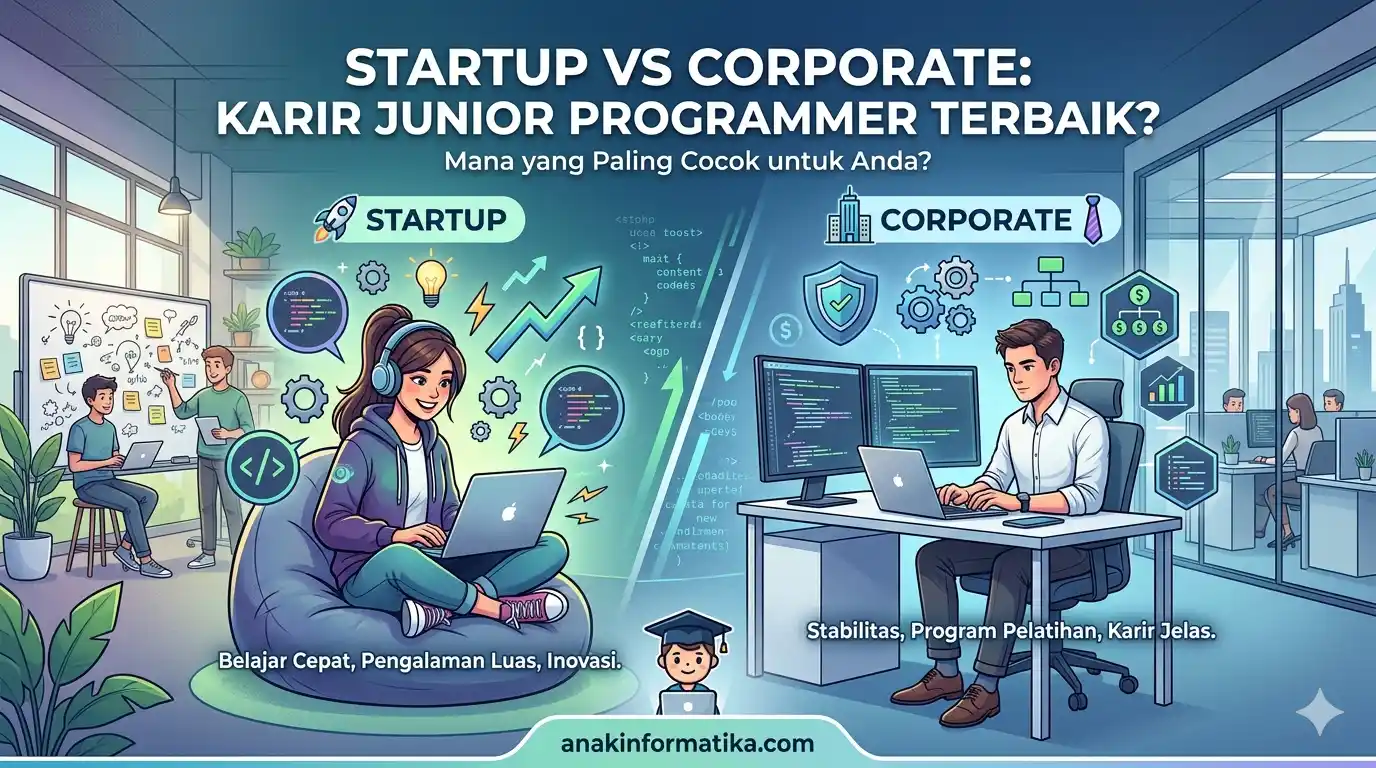
Welcome, aspiring digital talents at AnakInformatika! The moment of graduation or transition into the professional world is a new chapter full of excitement and questions. One of the most fundamental questions that often haunts junior developers is: "Which is better for starting my career, joining a dynamic startup or an established corporate?"
The question of Startup vs. Corporate: Which is the Best Place for Juniors to Start Their Career? is no trivial matter. Your decision at the beginning of your career can shape the foundation of your skills, network, and even your work philosophy for the future. There's no single "most correct" universal answer, as the best path heavily depends on your personal ambitions, risk tolerance, and learning style. This article will thoroughly explore both paths, providing you with a comprehensive perspective to make the most informed decision.
Understanding the Startup Environment: Dynamics and Innovation
A startup is a nascent company typically in its early stages of development, focused on innovation and rapid growth. They often strive to disrupt existing markets or create new ones with unique products or services. The work environment in a startup is known for being highly dynamic, fast-paced, and often full of uncertainty.
Advantages of Starting a Career at a Startup for Junior Developers:
- Rapid and Broad Learning: As a junior, you might be asked to work on various tasks beyond your core job description. This means you'll be exposed to diverse technologies, stacks, and product development aspects—from frontend, backend, database, DevOps, to basic business understanding. The learning process becomes highly intensive and comprehensive.
- Direct and Significant Impact: In a small team, each individual's contribution is highly noticeable. The code you write, the features you develop, or the bugs you fix have a direct impact on the product and the company's direction. This can be very satisfying and motivating.
- Flexibility and Autonomy: Startups tend to have minimal bureaucracy. Decision-making can be faster, and you might have more freedom to experiment with new ideas or technologies. The work culture is often more relaxed and collaborative.
- Intensive Mentoring: Although formal structures might be minimal, there are often opportunities to receive direct guidance from founders or highly experienced senior developers, who may be experts in their field.
- Rapid Career Growth Potential: As a startup grows, there are many opportunities for promotion or to take on leadership roles faster than in more established corporates.
- Innovative Culture: A startup environment encourages creative thinking and innovative problem-solving, which is excellent for developing your problem-solving skills.
Challenges of Starting a Career at a Startup for Junior Developers:
- High Workload and Long Hours: To achieve ambitious growth targets with limited resources, startups often demand longer working hours and high intensity.
- Uncertainty and Risk: Startups have a high failure rate. Funding uncertainty, changes in product direction, or fierce competition can pose risks to your job stability.
- Generally Lower Starting Salary: To conserve capital, startups might offer lower starting salaries compared to corporates, although this is often offset by stock options whose value can skyrocket if the company succeeds.
- Minimal Structure and Processes: A lack of established processes can be a double-edged sword. While flexible, it can mean a lack of formal guidance or structured training programs, which might overwhelm juniors.
- Limited Resources: You might not have access to the full suite of tools, software, or support teams found in large corporates.
Exploring the Corporate World: Stability and Structure
Corporates are large, established companies with a long history, clear organizational structures, and often operate across various markets or product lines. They tend to have thousands of employees and well-defined processes.
Advantages of Starting a Career at a Corporate for Junior Developers:
- Stability and Job Security: Established corporates tend to be more financially stable, offering higher job security and comprehensive employee benefits (health insurance, retirement plans, etc.).
- Competitive Salary and Benefits: Generally, corporates offer higher starting salaries and more comprehensive benefit packages compared to startups. This can be very attractive for juniors seeking financial stability.
- Structured Learning and Career Development: Corporates often have formal training programs, clear career paths, and budgets for certifications or conferences. You'll be guided through a structured process to develop your skills.
- Abundant Resources: You will have access to advanced tools, premium software licenses, support teams (IT support, HR, legal), and a robust infrastructure.
- Better Work-Life Balance: While not always the case, corporations tend to value work-life balance more, offering regular working hours and clear leave policies.
- Branding and Extensive Networking: Experience working at a major company can be a strong addition to your CV. Additionally, you will have the opportunity to network with professionals from various departments and levels.
- Deep Specialization: You will have the opportunity to dive deep into a specific technological field or role, becoming an expert in that area.
Challenges of Starting a Career in a Corporate Environment for Junior Developers
- Bureaucracy and Slow Processes: The large size of a company often means many layers of bureaucracy, which can slow down decision-making and the implementation of new ideas.
- Less Visible Individual Impact: In very large teams or projects, your contribution might feel like a drop in the ocean, making it difficult to see the direct impact of your work.
- Narrow Specialization: While there is an opportunity to specialize, sometimes junior roles can be very specific and repetitive, limiting your exposure to other aspects of product development.
- Slower Innovation: Corporations tend to be more cautious about adopting new technologies or changing business directions due to higher risks.
- Office Politics: Large corporate environments can be more susceptible to complex office political dynamics.
- Rigid Career Progression: Although there are clear career paths, promotions may take longer and involve tougher competition.
Comparison Table: Startup vs. Corporate for Junior Developers
- To make it easier for you to compare, here is a summary of the key differences:
Feature | Startup Environment | Corporate EnvironmentTeam & Company Size | Small to medium, growing rapidly. | Large, well-established, multinational.
Work Pace | Very fast, agile, frequently changing. | Measured, structured, tends to be stable.
Junior Scope of Work | Broad, diverse, full-stack, "do-it-all". | Specific, focused on one area.
Initial Salary & Benefits | Tends to be lower, equity potential. | Competitive, full benefit packages.
Learning Opportunities | Intensive, self-taught, direct from seniors. | Structured, formal training programs.
Job Stability | Relatively low, high risk. | Relatively high, secure.
Work Culture | Flexible, casual, innovative, collaborative. | Formal, hierarchical, organized.
Individual Impact | Highly visible, direct to product/company. | Less visible, part of a large team.
Career Path | Fast, if the company succeeds. | Clear, structured, but can be slow.
Resources | Limited, efficient. | Abundant, complete infrastructure. Choosing Tips: Which One is Right for You?
- There is no single answer to the question: Startup vs. Corporate: Which is the best place to start a career for a Junior? The key is understanding yourself and your priorities. Consider the following:
- Evaluate Personal Priorities:
- Do you prioritize fast learning and broad experience over stability and a high initial salary? If so, a startup might be a fit.
- Are you looking for security, structure, and a guaranteed work-life balance? A corporation could be the ideal choice.
- Are you a risk-taker ready to face uncertainty for high growth potential, or do you prefer a safe and predictable path?
- Your Learning Style:
- Do you learn best by "diving straight in" and solving problems yourself with little guidance? A startup is a perfect place to hone your independence.
- Do you need structured guidance, training programs, and clear mentors to grow? A corporation may offer a more suitable environment.
- In-depth Research: Don’t just get stuck on the "startup" or "corporate" label. Every company is unique. Research the company culture, the tech team, the types of projects they work on, and even employee reviews (e.g., on Glassdoor or LinkedIn).
- Leverage Your Network: Talk to alumni or seniors who have worked in both types of companies. Get a firsthand perspective on their experiences as juniors.
- Consider Long-Term Goals: Do you aspire to be a startup CTO, a solutions architect at a large firm, or even start your own company? Your first choice can be a strategic stepping stone.
- Don’t Be Afraid to Switch: Remember that a career is a journey. Your first choice doesn't have to be your last. Many developers start at startups to gain broad experience, then move to corporations for stability, or vice versa. Flexibility is key.
- Evaluate Personal Priorities:
Conclusion: Choose the Path That Best Suits You
- Ultimately, the decision between a startup and a corporation to start your career as a junior developer is a deeply personal one. No single path is inherently "better" than the other. What matters most is choosing the environment that best fits your personality, learning style, career ambitions, and current life priorities.
If you are a passionate, independent junior who is hungry for broad experience and doesn't mind challenges and uncertainty, then a startup can be an exciting arena for you. There, you can grow rapidly, see the direct impact of your work, and become an integral part of an innovative journey.
However, if you are looking for stability, structure, clear training programs, better work-life balance, and a competitive salary from the start, then a corporation might be the wiser choice. You will gain a strong foundation, learn from experts in the field, and build an extensive network in a more predictable environment.
Take the time to reflect on your priorities, do your research, and don’t hesitate to ask questions. Whatever your choice, remember that every experience is a learning opportunity. Good luck starting your career adventure in the tech world! AnakInformatika always supports your first step.