

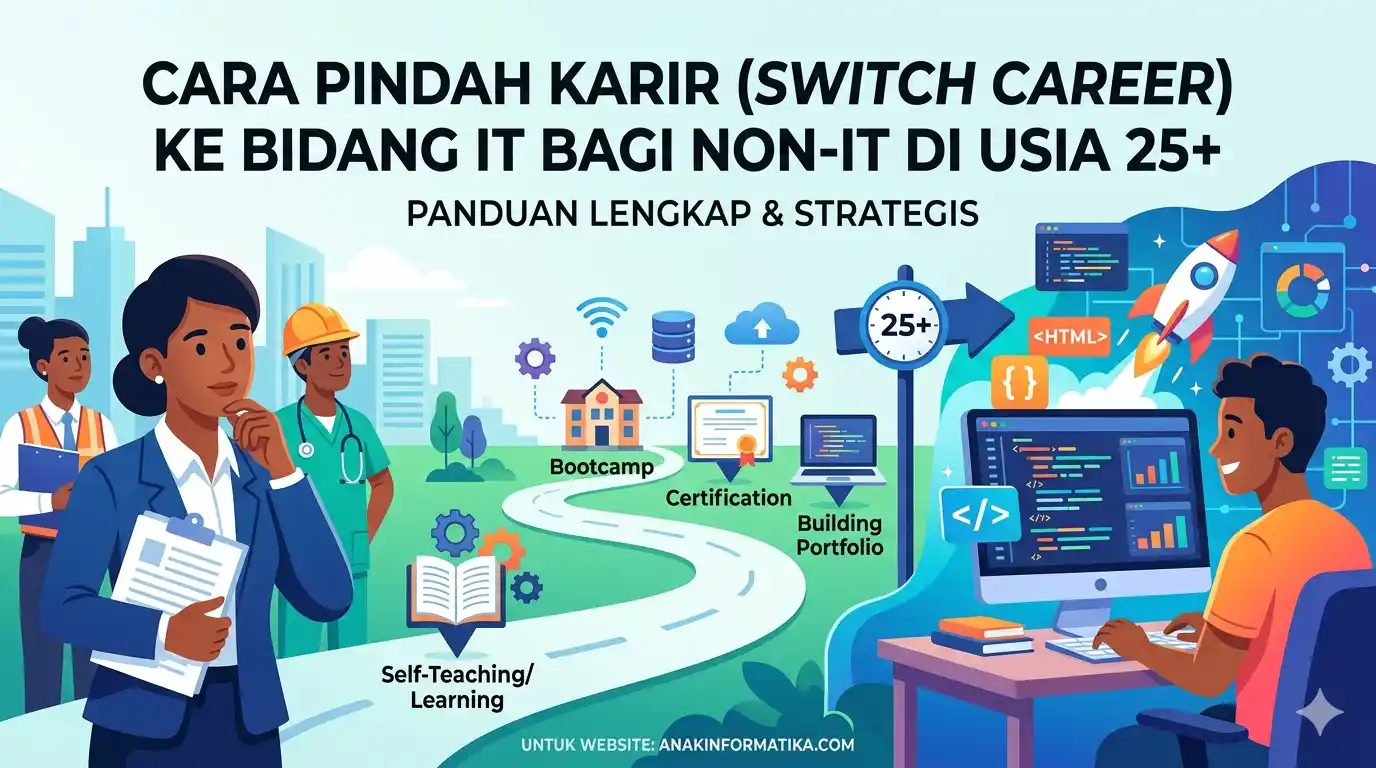
Have you ever felt stuck in an unchallenging career routine, knowing you have more potential than that? Perhaps you've witnessed the rapid advancement of technology and wondered, "Can I also be a part of this digital revolution?" If you're a non-IT professional and are now 25 years old or older, these feelings are perfectly normal. Many believe that to enter the IT world, one must have had a technical background since college or even childhood.
However, in this modern era, that paradigm is no longer relevant. The IT industry is increasingly open and values diverse backgrounds and experiences. This article will be your roadmap. We will thoroughly discuss How to Switch Careers to IT for Non-IT Professionals at 25+, debunk myths, and provide practical steps so you can transform into a competent and sought-after IT professional.
Why Switching to an IT Career is an Attractive Choice?
Deciding to make a career switch, especially at age 25+—which some often consider "late"—requires a strong motivation. The IT field offers several benefits that are hard to ignore:
- High Market Demand: Almost every industrial sector now depends on technology. This means there is a constant need for IT talent across various positions, from developers to cybersecurity analysts.
- Competitive Salary and Compensation: Generally, IT professionals tend to earn higher salaries compared to other industry averages, commensurate with their specialized skills.
- Work Flexibility: Many IT roles allow for remote work or flexible schedules, providing a better work-life balance.
- Opportunities for Innovation and Continuous Learning: The IT world is constantly evolving. it is a dynamic environment where you will consistently learn new things and contribute to innovation.
- Global Career Opportunities: IT skills are universal. The doors to multinational companies or even working abroad are wide open.
For those aged 25+, your previous work experience and maturity can actually be valuable assets that set you apart from younger IT talent. It’s not about starting from zero; it’s about building upon an existing foundation.
Myths and Realities of Switching to IT at 25+
Before we dive into practical steps, let’s clear up some common misconceptions:
- Myth: "I'm too old to start a new career in IT."
- Reality: Age 25+ or even 30+ is not a barrier. In fact, your life and professional experience bring perspective, maturity, and soft skills (such as time management, communication, and problem-solving) that are highly valued in the IT workplace. Companies look for individuals capable of learning and adapting, not just youth.
- Myth: "I must have been good at coding since I was a kid to enter IT."
- Reality: Coding is just one of many paths in IT. There are many non-coding or low-coding roles that are vital, such as UI/UX Designer, Data Analyst, IT Project Manager, QA Tester, or Business Analyst. Even for coding, many start learning as adults and succeed.
- Myth: "I have to go back to college for an IT degree."
- Reality: While an IT degree can help, it’s not the only way. Many successful IT professionals come from non-technical backgrounds and rely on online courses, bootcamps, certifications, and project portfolios as proof of their competence.
Strategic Steps for Non-IT Professionals Switching to IT at 25+
This is the core of how to transition. Every step needs to be carefully planned.
1. Self-Evaluation and Finding Your Niche
Don't rush. Start with introspection. What are your interests? What did you excel at in your previous career? What skills are transferable? The IT industry is vast:
- Software Development: Front-end, Back-end, Full-stack, Mobile.
- Data Science & Analytics: Data Analyst, Data Scientist, Machine Learning Engineer.
- Design (UI/UX): User Interface, User Experience.
- IT Project Management: Project Manager, Scrum Master.
- Cybersecurity, Cloud Computing, Technical Support, etc.
Pick one or two fields that align with your natural talents. Deep research is essential to ensure the path fits your expectations.
2. Build Your Foundation of Knowledge and Skills
You don't necessarily need a new degree:
- Self-Taught: Platforms like Coursera, Udemy, and freeCodeCamp offer thousands of courses. This is the most flexible and cost-effective option.
- Bootcamps: If you need structure and a 3–6 month fast-track to becoming job-ready, bootcamps are a great (though more expensive) investment.
- Industry Certifications: Certifications like AWS, CompTIA Security+, or PMP provide strong proof of competency.
3. Develop a Portfolio and Personal Projects
Theory isn't enough. Companies want to see what you can do.
- Personal Projects: Build simple websites or analyze public datasets.
- Open Source: Contribute to projects on GitHub to show collaboration skills.
- Hackathons: Great for learning and creating something under pressure.
4. Leverage Networking
The IT world relies heavily on connections:
- LinkedIn: Optimize your profile and connect with IT professionals.
- Communities: Join Discord, Telegram, or local IT groups.
- Events: Attend webinars and meetups to meet practitioners.
5. Prepare Your CV, Cover Letter, and Interview
- CV/Resume: Highlight transferable skills like problem-solving and project management. Include your portfolio links.
- Cover Letter: Explain how your non-IT background is actually a strength.
- Interview: Practice technical and behavioral questions. Show passion and a willingness to grow.
6. Start with Entry-Level Positions or Internships
Be realistic. You may need to start as a junior or intern. This is an investment in your future. Experience is the most valuable currency in this industry.
IT Career Paths Suitable for Non-IT Backgrounds
Leverage your existing skills in these roles:
- IT Project Manager / Scrum Master: Best for those with management and leadership experience.
- IT Business Analyst: Ideal for analytical thinkers who can bridge the gap between business needs and tech solutions.
- UI/UX Designer: Great for those with an eye for aesthetics and empathy for users.
- Quality Assurance (QA) Tester: Perfect for detail-oriented individuals who enjoy finding bugs.
- Technical Writer: For those skilled at explaining complex things simply.
- Data Analyst: For those who love numbers and finding patterns (e.g., from finance or research backgrounds).
Success Stories: Brief Case Studies
- Sarah (30), Former English Teacher: Took a 4-month UI/UX bootcamp. Her communication skills as a teacher helped her collaborate better with teams. She is now a Junior UX Designer.
- Rizky (28), Former Bank Officer: Self-taught SQL and Python. Leveraged his banking precision to become a Junior Data Analyst after 8 months of study.
Conclusion: Your First Step Toward a Digital Future
Switching to an IT career at 25+ is a major decision that is entirely achievable. Age is just a number, and your non-technical background can be a competitive advantage. With planning, persistence, and the right strategy, you can build a satisfying career in the tech industry.
The IT world is waiting for new talent with diverse perspectives. Don't hesitate to take that first step today!