

Berikut adalah hasil terjemahan lengkap artikel tersebut ke dalam bahasa Inggris dengan tetap mempertahankan struktur, gaya bahasa, dan format aslinya:
Hello AnakInformatika! In this interconnected digital era, web applications have become the backbone of almost all our daily activities. From online shopping, social media, and banking to government systems, everything runs on top of a web application foundation. However, have you ever imagined how vulnerable these applications are to cyberattacks?
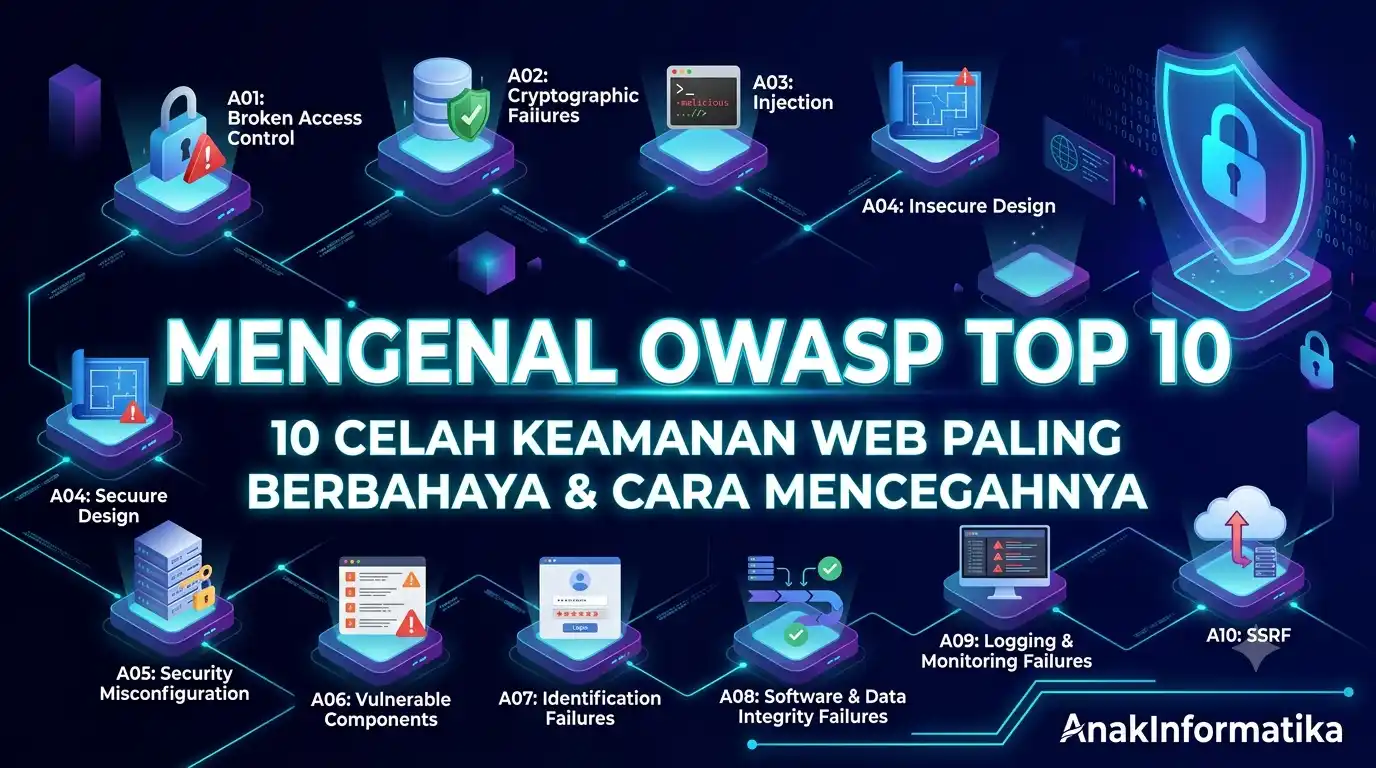
Cybersecurity threats are not something we can afford to ignore. A single small flaw can be fatal, leading to personal data breaches, financial losses, and destroyed reputations. To help us all understand and overcome these risks, the global cybersecurity community releases a crucial list: the OWASP Top 10. In this comprehensive guide, we will explore Getting to Know the OWASP Top 10: The Most Dangerous Web Security Vulnerabilities and How to Prevent Them.
Ready to dive into the world of web security and fortify your applications? Let’s get started!
What Is OWASP Top 10 and Why Should We Care?
OWASP (Open Web Application Security Project) is a non-profit organization dedicated to improving software security. They periodically release a list of the 10 most critical security risks for web applications, known as the OWASP Top 10. This list is not just theoretical; it is a compilation of real-world attack data, vulnerability analyses, and their associated impacts.
Why should you care? Because this list serves as a roadmap for developers, security professionals, and even casual users to understand the weak points most frequently exploited by attackers. By understanding the OWASP Top 10, you can take proactive steps to build, test, and secure web applications so they don't become the next victim.
In-Depth Look at the OWASP Top 10: Threats & Mitigations
Let's break down each risk in the OWASP Top 10 (2021 version) one by one, examining how attackers operate and the concrete steps needed to prevent them.
1. A01:2021 – Broken Access Control
-
Description: This vulnerability occurs when an application fails to properly enforce restrictions on what users can access or do. Attackers can exploit this flaw to access functions, data, or resources they shouldn’t have rights to.
-
How It Works / Attack Anatomy: Imagine an e-commerce application. A regular user should only be able to view their own orders, whereas an admin can view all orders. If access control is broken, a regular user might modify a URL or ID parameter and suddenly gain access to view or alter another user's order, or even access the admin page.
// Example of a vulnerable URL
https://shop.com/order?id=123 (User A's order)
https://shop.com/order?id=124 (User B's order, accessible by User A)
⚠️ Danger/Warning: Attackers can take over other users' accounts, view sensitive data, modify data, or even gain administrative privileges, leading to a complete system compromise.
-
🛡️ Mitigation Solutions:
-
Enforce the Principle of Least Privilege: Grant only the absolute minimum access required.
-
Perform server-side validation for every request to ensure the user is properly authorized to access the specific resource or function.
-
Use robust and proven access control mechanisms (e.g., Role-Based Access Control / RBAC).
-
Disable directory listing on the web server.
-
2. A02:2021 – Cryptographic Failures
-
Description: Previously known as "Sensitive Data Exposure." This vulnerability occurs when sensitive data (such as credentials, credit card details, or personal data) is not adequately protected, either at rest or in transit.
-
How It Works / Attack Anatomy: Attackers don't need to break encryption if the encryption itself is weak or missing. For instance, an application might store user passwords in plaintext or use an outdated, easily cracked hashing algorithm. When attackers gain access to the database, they can immediately read those passwords.
⚠️ Danger/Warning: Unprotected sensitive data leaks can lead to identity theft, financial fraud, or other misuses of personal information.
-
🛡️ Mitigation Solutions:
-
Encrypt all sensitive data, both at rest and in transit, using strong, industry-standard cryptographic algorithms (e.g., AES-256 for data at rest, TLS 1.2+ for data in transit).
-
Never store user credentials in plaintext. Use strong hashing functions with salt (e.g., Argon2, bcrypt, scrypt).
-
Discard sensitive data as soon as it is no longer needed.
-
Ensure SSL/TLS certificates are configured correctly.
-
3. A03:2021 – Injection
-
Description: Injection vulnerabilities occur when untrusted data is sent to an interpreter as part of a command or query. Attackers can supply malicious data to trick the interpreter into executing unintended commands.
-
How It Works / Attack Anatomy: The most famous injection is SQL Injection. Attackers input malicious SQL code into an application input form, which is then executed by the database. Other examples include Command Injection and LDAP Injection.
-- Example of SQL Injection in a login form
Username: ' OR '1'='1 --
Password: anypassword

-- The payload transforms the SQL query into:
SELECT * FROM users WHERE username = '' OR '1'='1' -- AND password = 'anypassword'
-- Because '1'='1' is always true, the attacker can log in without knowing the password.
⚠️ Danger/Warning: Attackers can read, modify, or delete database contents, execute system commands, or take full control of the application server.
-
🛡️ Mitigation Solutions:
-
Use Prepared Statements with parameterized queries to prevent SQL Injection.
-
Validate and sanitize all user input on the server side.
-
Use safe Object-Relational Mapping (ORM) tools.
-
Apply the Principle of Least Privilege to database accounts.
-
4. A04:2021 – Insecure Design
Description: This category focuses on risks related to flaws in design or architecture. It is not about implementation bugs, but rather inherent weaknesses present from the design phase itself.
Read more : Baca juga : Cara Melakukan Vulnerability Scanning
How It Works / Attack Anatomy: An example is a system designed without rate-limiting constraints on API endpoints, allowing attackers to easily perform brute-force attacks. Another example is relying on client-side modifiable data for authorization without server-side validation.
⚠️ Danger/Warning: Design weaknesses open the door to various attacks—ranging from brute-force and authorization bypasses to denial-of-service—because the underlying security foundation was fragile from the start.
-
🛡️ Mitigation Solutions:
-
Apply Secure Design Patterns and security principles from the beginning of the development cycle (Security by Design).
-
Perform threat modeling to identify potential threats and design weaknesses.
-
Implement rate limiting on APIs and sensitive endpoints.
-
Segregate functionality and data based on trust levels.
-
5. A05:2021 – Security Misconfiguration
-
Description: This vulnerability results from incorrect security configurations on servers, frameworks, libraries, or the application itself. It is one of the most common and frequently easy-to-exploit flaws.
-
How It Works / Attack Anatomy: Examples include unmanaged default credentials, enabled directory listing, overly verbose error messages (revealing internal system structure), or accidentally disabled security features. Attackers look for weak configurations to gather information or gain access.
// Example of a potentially dangerous Nginx configuration (directory listing enabled)
server {
    listen 80;
    server_name example.com;
    root /var/www/html;
    autoindex on; # This is dangerous!
}
⚠️ Danger/Warning: Attackers can gain unauthorized access, obtain sensitive details about the infrastructure, or execute arbitrary remote code.
-
🛡️ Mitigation Solutions:
-
Implement a strict hardening process for all servers, databases, and application components.
-
Change all default credentials.
-
Remove or disable unused features and components.
-
Ensure generic error messages are displayed to end-users instead of detailed technical stack traces.
-
Perform regular patching and monitor configuration changes.
-
6. A06:2021 – Vulnerable and Outdated Components
-
Description: Modern applications rely heavily on third-party libraries, frameworks, and components. If these components contain known vulnerabilities or are outdated, the entire application becomes vulnerable.
-
How It Works / Attack Anatomy: Attackers frequently scan applications to identify the versions of components being used (e.g., specific versions of jQuery, Apache Struts, OpenSSL). If a version has a known CVE (Common Vulnerabilities and Exposures), attackers use publicly available exploits to attack the application.
⚠️ Danger/Warning: Vulnerabilities in third-party components can allow attackers to compromise the server, steal data, or launch Denial-of-Service (DoS) attacks without needing to find a new flaw in your custom code.
-
🛡️ Mitigation Solutions:
-
Maintain an inventory of all third-party components used in the application.
-
Use vulnerability scanning tools (e.g., Dependabot, Snyk, OWASP Dependency-Check) to identify vulnerable components.
-
Regularly update components to their latest stable and secure versions.
-
Remove unused or obsolete dependencies.
-
7. A07:2021 – Identification and Authentication Failures
-
Description: Formerly known as "Broken Authentication." This vulnerability occurs when functions related to user identity, authentication, and session management are incorrectly implemented, allowing attackers to impersonate legitimate users.
-
How It Works / Attack Anatomy: Examples include systems that permit brute-forcing on login forms without rate limits, or using predictable session IDs. Attackers can repeatedly guess passwords, hijack session tokens, or bypass authentication flows.
⚠️ Danger/Warning: Attackers can compromise user accounts, access sensitive data, or perform unauthorized actions on behalf of legitimate users, leading to financial loss and reputational damage.
-
🛡️ Mitigation Solutions:
-
Implement Multi-Factor Authentication (MFA) wherever possible.
-
Use strong password hashing algorithms with salt (Argon2, bcrypt, scrypt).
-
Apply rate limiting on authentication attempts.
-
Use strong, random, and secure session identifiers, ensuring sessions expire after periods of inactivity.
-
Avoid default or weak credentials.
-
8. A08:2021 – Software and Data Integrity Failures
-
Description: This category focuses on unverified assumptions regarding the integrity of software updates, critical data, and CI/CD pipelines. Attackers can exploit these gaps to upload unauthorized updates, compromise repositories, or tamper with source code.
-
How It Works / Attack Anatomy: An example is an application that automatically downloads updates without verifying their digital signature or hash. Attackers can inject malicious code directly into the update delivery channel. Alternatively, an insecure CI/CD pipeline could allow attackers to inject malicious code during the build process.
⚠️ Danger/Warning: Attackers can inject malware, take over systems, or manipulate critical data, leading to widespread and difficult-to-detect compromises.
-
🛡️ Mitigation Solutions:
-
Verify code and data integrity using digital signatures or cryptographic hashes.
-
Secure software update channels and CI/CD pipelines.
-
Use trusted repositories and ensure only authorized code is deployed.
-
Implement strict configuration management.
-
9. A09:2021 – Security Logging and Monitoring Failures
-
Description: Formerly "Insufficient Logging & Monitoring." This occurs when an application lacks adequate logging and monitoring controls, or when log systems are not actively reviewed. This makes detecting and responding to active attacks extremely difficult.
-
How It Works / Attack Anatomy: Without sufficient event logging, attackers can operate undetected. For instance, if failed login attempts are not recorded, an attacker can launch a brute-force attack without triggering any alerts. If logs are unmonitored, a successful breach might go unnoticed for months.
⚠️ Danger/Warning: Without effective logging and monitoring, cyberattacks can persist over long periods, allowing attackers to exfiltrate vast amounts of data or gradually destroy system integrity.
-
🛡️ Mitigation Solutions:
-
Implement comprehensive logging for all security events (logins, authorization checks, data modifications, errors).
-
Ensure logs are protected against unauthorized modification or deletion.
-
Utilize SIEM (Security Information and Event Management) tools to aggregate, analyze, and monitor logs in real-time.
-
Define alert thresholds and automate incident response actions.
-
10. A10:2021 – Server-Side Request Forgery (SSRF)
-
Description: SSRF emerged as a dedicated category due to the rise of cloud adoption and microservices architectures. It occurs when a web application fetches a remote resource without fully validating the user-supplied URL, allowing an attacker to coerce the server into sending requests to unintended destinations.
-
How It Works / Attack Anatomy: Consider an application that allows users to upload a profile picture via an external URL. If the URL is not validated, an attacker can enter internal system URLs (e.g.,
http://localhost/adminor[http://169.254.169.254/latest/meta-data/](http://169.254.169.254/latest/meta-data/)for AWS metadata), forcing the server to access those resources and return sensitive internal data.
// Example of a vulnerable URL
https://app.com/get_image?url=http://malicious.com/image.jpg

// Attacker alters it to:
https://app.com/get_image?url=http://127.0.0.1/admin_panel
⚠️ Danger/Warning: Attackers can scan internal ports, access unexposed internal services, or steal cloud metadata credentials, leading to broader infrastructure compromise.
-
🛡️ Mitigation Solutions:
-
Validate all user-supplied input URLs.
-
Implement allowlists (whitelists) for allowed remote hostnames, IP addresses, and URL schemes.
-
Disable support for relative URLs or internal IP addresses.
-
Implement network segmentation and firewalls to restrict outgoing traffic from application servers.
-
Deploy a Web Application Firewall (WAF) to detect and block SSRF attempts.
-
Why Is OWASP Top 10 Important for You?
As someone interested in computer science and IT, mastering the OWASP Top 10 is an invaluable skill. Whether you are a developer, QA engineer, sysadmin, or a student learning to code, this list will guide you to:
-
Build More Secure Applications: By understanding risks early on, you can write cleaner, safer code and design resilient architectures.
-
Identify and Fix Vulnerabilities: You will know exactly what to look for when performing security tests or addressing bug reports.
-
Communicate Effectively: OWASP terminology is the global standard language of the cybersecurity industry, enabling clear communication with colleagues and clients.
-
Advance Your Career: Cybersecurity awareness is in high demand in the job market, making you a vital asset to any organization.
Comprehensive Strategies to Protect Your Web Applications
In addition to specific mitigations, here are general best practices to harden your web application defenses:
| Strategy | Description |
| Education & Awareness | Ensure the entire team, from developers to management, understands the importance of cybersecurity. |
| Security by Design | Integrate security measures into every phase of the Software Development Life Cycle (SDLC). |
| Code Review & Testing | Conduct manual code reviews and automated security testing, such as SAST, DAST, and Penetration Testing. |
| Patch Management | Keep operating systems, web servers, databases, frameworks, and libraries updated with the latest security patches. |
| Web Application Firewall (WAF) | Use a WAF to detect and block common application-layer attacks. |
| Network Security | Implement network segmentation, strict firewalls, and Intrusion Detection/Prevention Systems (IDS/IPS). |
| Incident Response Plan | Prepare a clear, actionable plan for responding to security breaches effectively. |
Conclusion
Getting to know the OWASP Top 10 is not the end of your cybersecurity journey, but a crucial beginning. This list serves as a reminder that threats are constantly evolving, requiring us to continuously learn and adapt. By understanding these dangerous security flaws and implementing proper defensive measures, you take a major step toward protecting your applications from malicious actors.
Security is a shared responsibility. Let's build a safer web together!
Stay safe, AnakInformatika!