

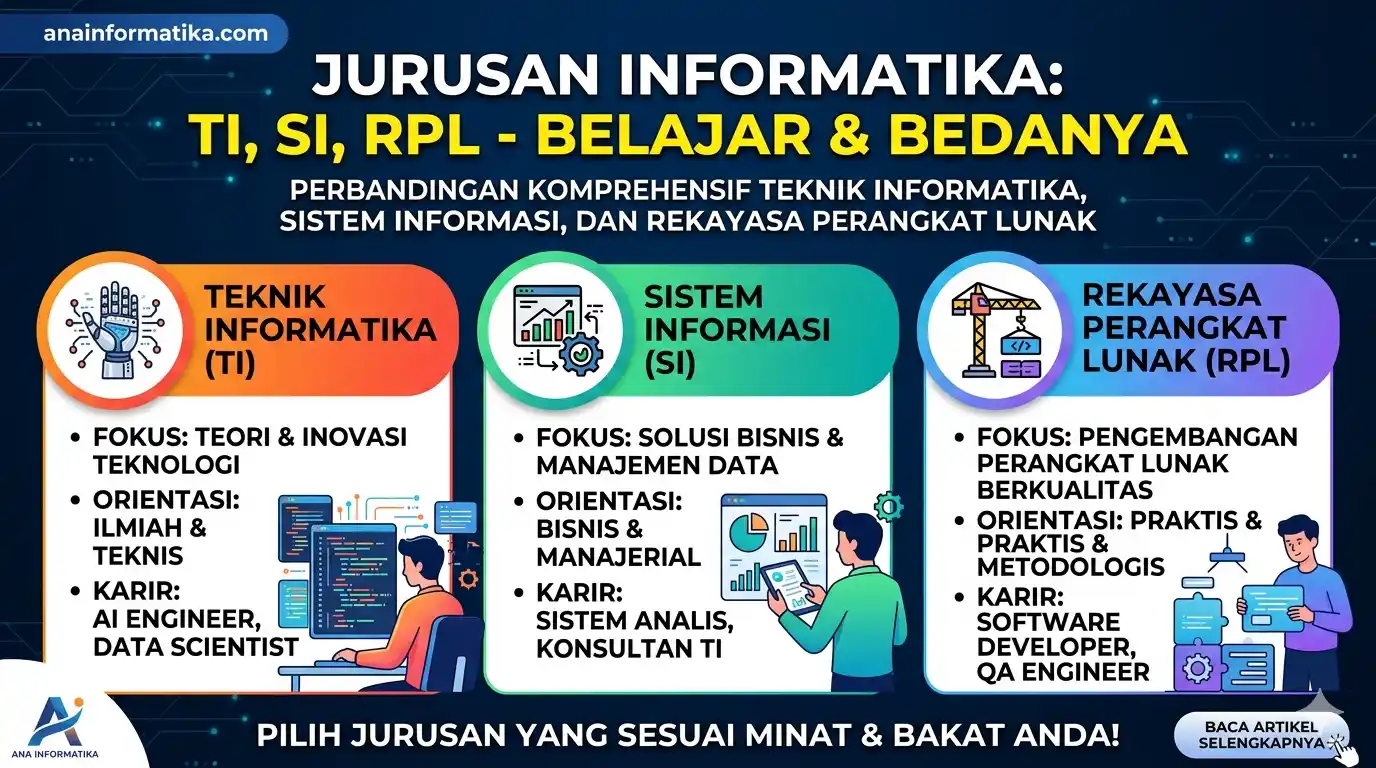
Welcome to the digital era, where information technology has become the backbone of almost every aspect of life. It's no surprise that Computer Science and Informatics programs are among the most popular choices for young people looking to contribute to the world of technology. Yet, despite their popularity, confusion often arises: What exactly do you learn in Computer Science and Informatics? And even more perplexing, what are the actual differences between Computer Science, Information Systems, and Software Engineering (SE)?
If you're looking for answers to these questions, you've come to the right place! This article will thoroughly explore the intricacies of these three disciplines, explaining their core curricula, learning focuses, and the career prospects that await. Let's dive into this dynamic world of Informatics!
What Do Computer Science and Informatics Programs Generally Cover?
Before discussing specific differences, it's important to understand the foundational knowledge generally taught across all Computer Science and Informatics disciplines. While there are variations, most of these study programs will equip their students with strong fundamentals in:
- Programming & Algorithms: This is the core of all computer science disciplines. You will learn various programming languages (Python, Java, C++, JavaScript, etc.), understand data structures, and design efficient algorithms to solve computational problems.
- Databases: How data is effectively stored, organized, accessed, and managed is key. You will study relational and non-relational database design, SQL, and database management systems (DBMS).
- Computer Networks: Understanding how computers communicate with each other, network protocols (TCP/IP), network security, and internet architecture is a crucial part.
- Operating Systems: Learning about how operating systems like Windows, Linux, or macOS work, memory management, processes, and files.
- Data Structures: Studying various ways to organize data (arrays, linked lists, trees, graphs) to make programs more efficient.
- Discrete Mathematics & Logic: Crucial mathematical foundations for computational thinking, understanding algorithms, and digital circuit design.
- Introduction to Artificial Intelligence (AI) & Machine Learning: Recognizing the basic concepts of AI, machine learning, and how computers can learn from data.
- Web & Mobile Development: Some programs also introduce the fundamentals of web or mobile application development.
In short, generally, Computer Science and Informatics programs cover strong computational foundations, enabling graduates to adapt to various roles in the technology industry.
Understanding the Fundamental Differences: Computer Science, Information Systems, and Software Engineering
Now that we've covered the basics, let's break down the fundamental differences that often pose a big question. Although all three are within the same family of disciplines, their focus and approach are distinctly different.
1. Computer Science (CS) – The "Deep Dive" into Computer Science
Computer Science, often simply referred to as CS, is the discipline most closely aligned with the foundations and theory behind computers and computation. If you enjoy delving into how things work at the most fundamental level, CS is the right choice.
Computer Science Learning Focus:
- Theory of Computation: Delving into fundamental concepts like algorithm complexity, formal language theory, and mathematical logic that form the basis of computer science.
- Computer Architecture & Organization: Studying how hardware and software interact, processor design, memory, and I/O systems.
- Advanced Operating Systems: Not just how to use them, but how operating systems are built and optimized.
- Artificial Intelligence (AI) & Machine Learning (ML): A deeper dive into AI and ML algorithms, models, and implementation, including data science.
- Computer Graphics & Computer Vision: Creating and manipulating digital images, and how computers "see" and understand the visual world.
- Computer Networks & Cybersecurity: Network design, advanced protocols, and cyber defense strategies.
- Advanced Programming: Focusing on efficiency, performance, and code optimization.
Computer Science graduates tend to become innovators capable of developing new technologies, solving complex computational problems, or becoming researchers in the field of computer science.
2. Information Systems (IS) – The Bridge Between Tech and Business
Information Systems is a discipline that bridges the world of technology with the world of business. If you're interested in how technology can be used to enhance efficiency, decision-making, and business value, IS is the right path for you. This program not only focuses on how to build systems but also why they are built and how they impact organizations.
Information Systems Learning Focus:
- Systems Analysis and Design: Understanding business needs, analyzing existing processes, and designing effective information systems.
- IT Project Management: Managing the technology project lifecycle, from planning to implementation and maintenance.
- Advanced Database Management: Focusing on how data can be organized and analyzed to support business decisions (business intelligence).
- Enterprise Systems (ERP, CRM, SCM): Studying the implementation and management of integrated information systems for large enterprises.
- IS Audit & IT Governance: Ensuring information systems operate according to standards, are secure, and support the company's strategic objectives.
- E-Business & E-Commerce: Building and managing digital-based business strategies.
- Introduction to Accounting & Business Management: Understanding the fundamentals of business operations and strategy.
Information Systems graduates often serve as IT consultants, systems analysts, project managers, or developers with a strong business acumen.
3. Software Engineering (SE) – The Art & Science of Building Software
Software Engineering is a discipline that focuses on the systematic and disciplined process of building, developing, and maintaining high-quality, efficient, and reliable software. If you enjoy designing, building, and testing complex applications with structured methodologies, SE is an ideal choice.
Software Engineering Learning Focus:
- Software Development Life Cycle (SDLC): Studying all phases, from requirements analysis, design, implementation, testing, to maintenance.
- Development Methodologies (Agile, Scrum, Waterfall): Mastering various approaches to managing software development projects.
- Software Design & Architecture: Designing robust, scalable, and maintainable software structures.
- Software Testing: Various techniques and tools to ensure application quality, functionality, and security.
- Configuration Management: Effectively managing code changes and software versions.
- Software Quality Assurance (SQA): Ensuring the final product meets established quality standards.
- Software Security: Developing applications with security considerations from the outset.
- Object-Oriented Programming (OOP) & Design Patterns: Applying best practices in coding to create clean and structured code.
Software Engineering graduates are professionals skilled in building applications, whether as a software developer, quality assurance (QA) engineer, DevOps engineer, or software architect.
Comparison Table of Computer Science and Informatics Programs
To make it easier to understand, here is a brief comparison table between Computer Science, Information Systems, and Software Engineering:
| Aspect | Computer Science (CS) | Information Systems (IS) | Software Engineering (SE) |
| Primary Focus | Computational theory, algorithms, hardware-software, and technological innovation. | Applying IT for business solutions, data management, and organizational strategy. | Systematic processes for developing high-quality software. |
| Orientation | Scientific & Technical (focuses on "how it works"). | Business & Managerial (focuses on "why and for what"). | Practical & Methodological (focuses on "how to build it"). |
| Key Subjects | AI, Machine Learning, Computer Graphics, Computer Architecture. | Systems Analysis, IT Project Management, Enterprise Systems, Business Intelligence. | SDLC, Agile Methodologies, Software Testing, Design Patterns. |
| Key Skills | Complex problem solving, abstract thinking, algorithm optimization. | Business requirements analysis, communication, project management, strategy. | Architectural design, clean coding, testing, development lifecycle management. |
| Career Examples | AI Engineer, Data Scientist, Researcher, Operating Systems Developer. | Systems Analyst, IT Consultant, IT Project Manager, Business Analyst. | Software Developer, QA Engineer, DevOps Engineer, Software Architect. |
Choosing the Right Major: Your Interest is Key
After understanding what Informatics majors study and the differences between Computer Science, Information Systems, and Software Engineering, the next question is: which one is best for you? The answer depends entirely on your passion:
- If you are fascinated by the core concepts behind technology, love solving highly complex problems, and are interested in research or developing cutting-edge technology, Computer Science is likely your best choice.
- If you enjoy seeing how technology helps businesses, are interested in project management and user requirements analysis, and want to be the bridge between the technical and non-technical worlds, Information Systems is your path.
- If you love the process of building applications, want to create functional, reliable, high-quality software, and are interested in modern development methodologies, Software Engineering will be a perfect fit.
Conclusion
The world of Informatics offers various exciting paths that are all crucial to technological advancement. Whether it is Computer Science, Information Systems, or Software Engineering, all three will equip you with knowledge and skills that are highly sought after in today's job market. The most important thing is to choose the path that best aligns with your talents, interests, and career goals.
Don’t hesitate to look for more information, talk to students or alumni from each major, and follow your intuition. The digital future is waiting for you to shape it!