

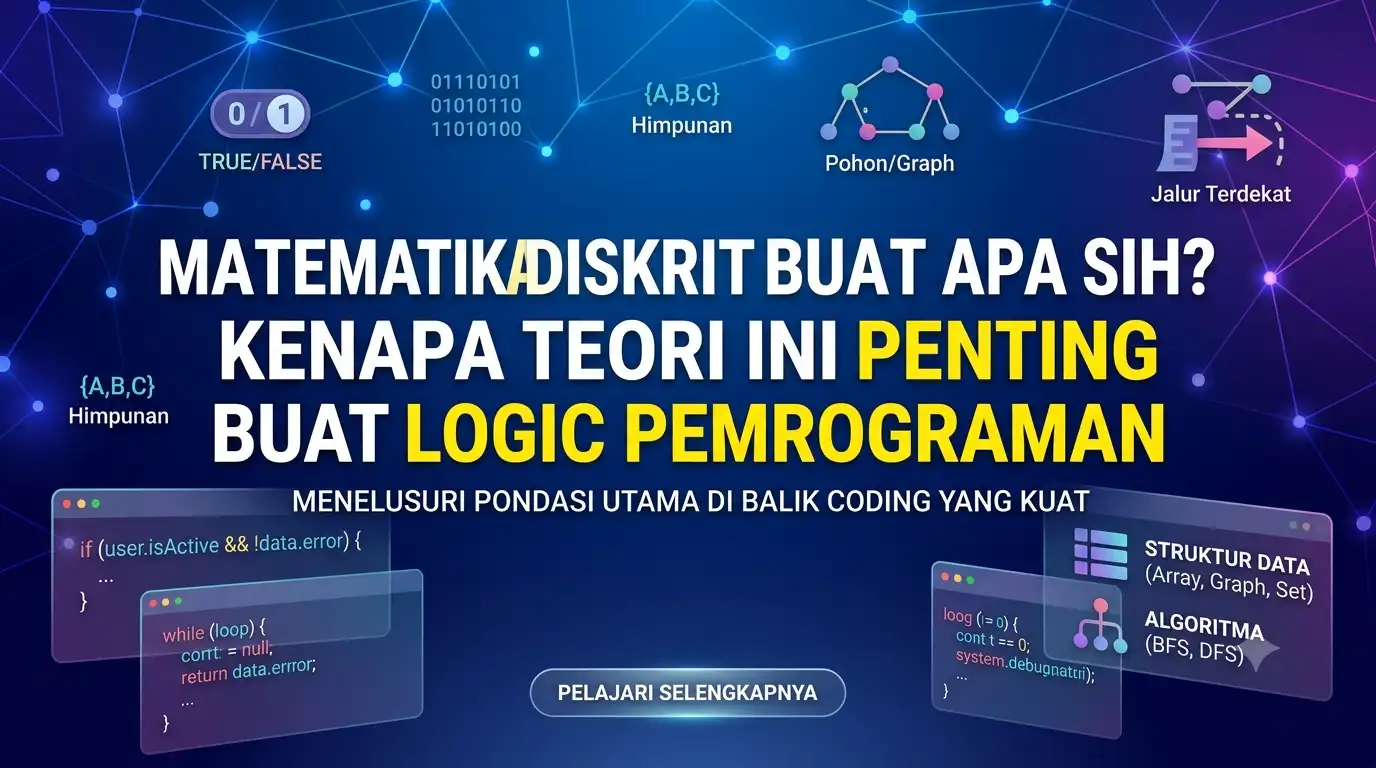
Hello, fellow tech enthusiasts! Have you ever felt stuck when facing complex algorithms, or struggled to design efficient data structures? Perhaps you've also wondered, "What is Discrete Mathematics for? Why is this theory important for programming logic?" This is a very common question, especially if you find mathematics "intimidating" and far removed from your daily coding activities.
But make no mistake! Behind every sophisticated application, stable operating system, and complex game, there's a very strong logical foundation. And that foundation, for the most part, is built upon Discrete Mathematics. Let's explore together why you, as a developer, absolutely need to be familiar with this branch of mathematics!
What is Discrete Mathematics? More Than Just Complex Numbers!
Before we go any further, let's first understand what Discrete Mathematics is. Simply put, Discrete Mathematics is a branch of mathematics that studies discrete objects, meaning objects that are separate or non-continuous. In contrast to continuous mathematics (like calculus), which studies things that change smoothly and continuously (e.g., curves, velocity), Discrete Mathematics deals with things that can be counted one by one.
Examples of discrete objects include integers, graphs, sets, or logical statements that can only be "true" or "false." Now, if you notice, all these things are very familiar in the world of programming, aren't they? Integer variables, graph data structures, arrays (sets), or if-else conditions—all of them are discrete concepts!
ℹ️ Did You Know? The concept of "discrete" comes from the Latin word "discretus," meaning "separate." This reflects the fundamental nature of objects studied in Discrete Mathematics: they have clear boundaries and can be counted individually.
Why is Discrete Mathematics So Crucial for Programming Logic?
Now we get to the core of the discussion. Why is this theory of Discrete Mathematics so crucial for building robust programming logic? Here are some reasons:
1. Foundation for Algorithms and Data Structures
Almost all algorithms you learn—from sorting, searching, to pathfinding—are rooted in Discrete Mathematics concepts. For instance, BFS (Breadth-First Search) or DFS (Depth-First Search) algorithms, often used to traverse tree or graph data structures, are all direct applications of discrete graph theory. Data structures like linked lists, arrays, stacks, queues, trees, and graphs themselves are discrete representations of information.
2. Boolean Logic and Logic Gates
Every time you write an if-else condition, a while loop, or logical operations like AND, OR, NOT, you are applying Boolean Logic, one of the main pillars of Discrete Mathematics. This logic is the foundation of all decision-making within programs. Without a strong understanding of this logic, it would be challenging to create programs that can "think" and respond accurately to various scenarios.
3. Set Theory for Data Management
Have you ever worked with relational databases? Concepts like relations, unions, intersections, and differences between tables are very similar to set operations in Discrete Mathematics. Understanding set theory will help you design efficient databases, write optimal queries, and manage data collections more effectively.
4. Graph Theory for Complex Problem Solving
Graph theory is one of the stars of Discrete Mathematics. Imagine social networks, road maps, internet connection paths, or even dependencies between modules in a project. All of these can be modeled as graphs. With graph theory, you can find the shortest routes, detect cycles, or analyze connectivity, which is extremely useful in developing network-based applications, games, or recommendation systems.
5. Combinatorics and Discrete Probability for Optimization
When you need to calculate how many ways to arrange certain objects (e.g., all possible password combinations), or analyze the likelihood of an event (e.g., what's the probability your algorithm finds a solution within a certain time), that's where combinatorics and discrete probability come into play. These are crucial for algorithm optimization, simulations, and performance analysis.
6. Program Proof and Verification
How can you be sure that your program truly works as expected under all conditions? Discrete Mathematics equips you with tools for formal proof, such as mathematical induction or indirect proof. This is vital in developing critical systems that demand high reliability.
ℹ️ Did You Know? Mathematical Induction, a proof technique in Discrete Mathematics, is often used to prove the correctness of a recursive algorithm or to analyze the time complexity of a loop that runs repeatedly.
Table: Discrete Mathematics Concepts & Their Applications in Programming
To make things even clearer, here is a quick breakdown of key Discrete Math concepts and how they directly map to programming:
| Discrete Math Concept | Brief Description | Real-World Application in Programming |
| Propositional & Predicate Logic | Study of statements (propositions) that are true or false, and how to connect them. | if-else conditions, switch-case statements, boolean expressions, input validation. |
| Set Theory | Study of collections of distinct objects (sets) and their operations (union, intersection, etc.). | Database management (SQL JOINs), data collections (Set in JS/Java), filtering data. |
| Relations & Functions | How objects relate to one another; mapping inputs to outputs. | Database table relationships, object mapping (Map in JS/Java), functions in code. |
| Graph Theory | Study of graphs (nodes and edges) to model relationships. | Pathfinding algorithms (Google Maps), social networks (Facebook), dependency trees. |
| Trees | A specialized graph without cycles, ideal for representing hierarchies. | Directory structures, the DOM (Document Object Model), Binary Search Trees. |
| Combinatorics | Study of counting possibilities, arrangements, or combinations of objects. | Password generation, game AI probability analysis, scheduling optimization. |
| Recursion | Defining something in terms of itself. | Recursive functions, tree/graph traversals, divide-and-conquer algorithms. |
When Do You Experience the Benefits of Discrete Math Firsthand?
You might still think, "Okay, that’s great in theory, but when do I actually use it?" Trust me, you’re probably using it already without realizing it! Here are a few everyday scenarios where it shines:
-
Optimizing Database Queries: Understanding set theory enables you to write faster, far more efficient SQL queries.
-
Building Search Features: Search algorithms (like those on e-commerce platforms) rely heavily on efficient, discrete data structures.
-
Creating Recommendation Systems: Systems like Netflix or Spotify use graph theory to uncover relationships between users and media.
-
Developing Game AI: Enemy decision-making, character pathfinding, and move-probability calculations all depend on Discrete Math.
-
Analyzing Algorithm Complexity (Big O Notation): This crucial aspect of Discrete Math helps you predict how your code scales as input sizes grow.
-
Debugging Complex Logic: When tracking down a bug in nested
if-elsestatements, Boolean logic gives you the exact tools to trace the execution flow.
Ultimately, Discrete Mathematics isn't just for computer scientists or processor designers. It’s a practical, everyday tool that every developer—from front-end to back-end—can use to build smarter, faster, and more robust applications.
Don't Be Afraid of Discrete Math!
Now you know the answer to "What is Discrete Math for?" It is the invisible backbone supporting almost every line of code we write. By mastering these concepts, you won't just become a better coder—you'll become a sharper, more innovative problem solver.
So, don't let math scare you off! View it as a workout for your logical brain. Start with the basics like Boolean logic or set theory, and watch your coding skills level up dramatically.