

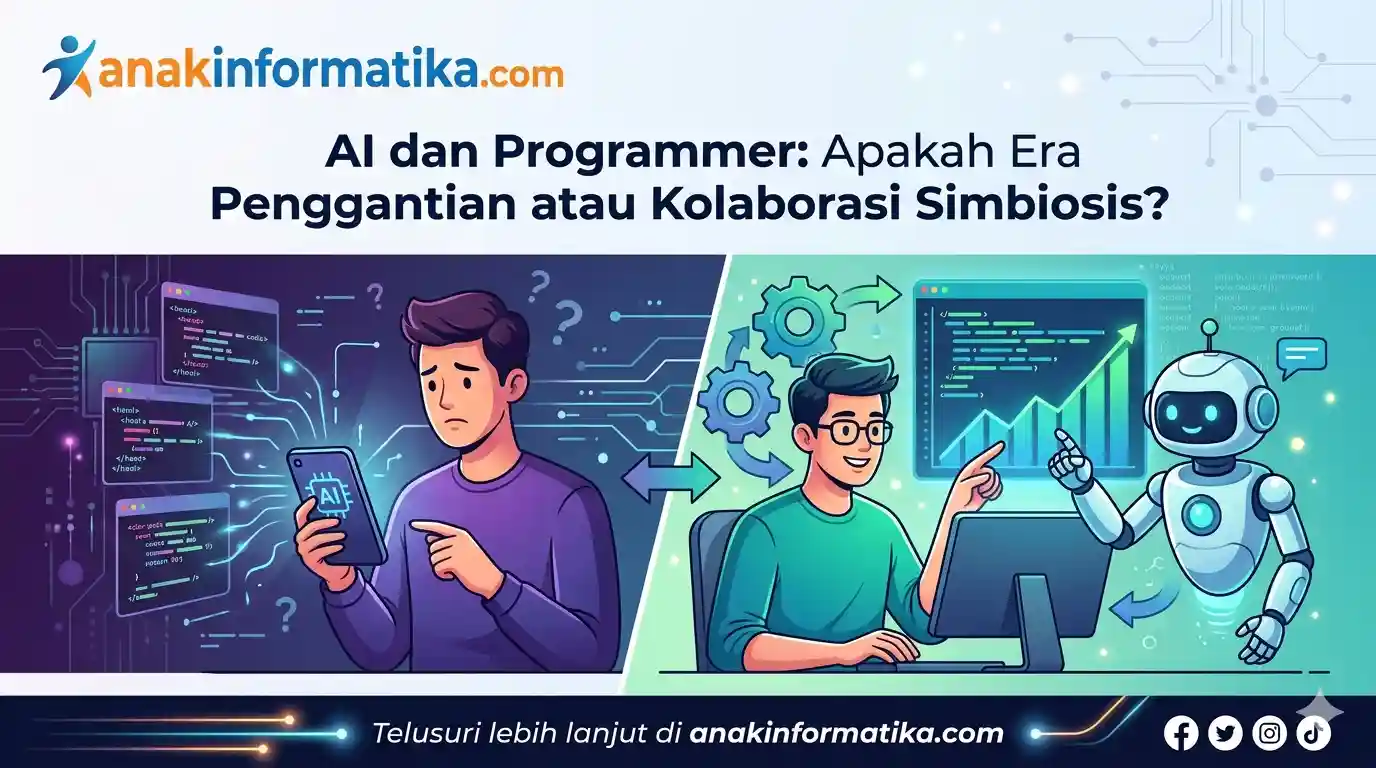
The rapid advancement of artificial intelligence (AI) has sparked a wave of questions and concerns across various industries, and the world of programming is no exception. With AI's increasingly sophisticated capabilities in generating code, performing debugging, and even designing simple architectures, a fundamental question naturally arises: Will AI replace programmers? This question cannot be answered with a simple "yes" or "no." To gain an objective understanding, we need to delve deeper into how AI interacts with the programming profession, where its strengths lie, and what its limitations are.
This article will thoroughly examine this issue from an objective standpoint, analyzing the current landscape, future potential, and the crucial role that humans will continue to play in the software development ecosystem. Let's dive deeper.
AI in the Software Development Ecosystem: Evolution or Revolution?
AI has permeated various aspects of software development, transforming how we work from the most fundamental tasks to the most complex. Tools like GitHub Copilot, ChatGPT, and various other Large Language Models (LLMs) have demonstrated incredible capabilities in assisting programmers. They can suggest lines of code, complete functions, and even write entire blocks of code based on brief descriptions. This is no longer science fiction; it is a reality utilized by millions of developers every day.
The current role of AI goes beyond simple autocomplete. AI is also used to analyze existing codebases, identify potential bugs, suggest refactoring to improve efficiency, and even assist in the testing process by generating test scenarios. Thus, AI acts as a highly efficient intelligent assistant, accelerating the development process and reducing the burden of repetitive tasks.
The Current Role of AI: An Intelligent Assistant, Not a Full Replacement
Currently, AI's primary strength in programming lies in its ability to identify and replicate patterns from massive amounts of data. When you ask an AI to write a function to sort an array or create a database connection, it doesn't truly "understand" your goal deeply. Instead, it predicts the most likely sequence of words or tokens based on billions of code examples it has been trained on across the internet.
This makes AI an exceptional tool for well-structured tasks, such as generating boilerplate code, fixing syntax, or suggesting standard algorithm implementations. AI can significantly speed up the coding process, freeing programmers from mechanical work. However, it is crucial to emphasize that this AI output still requires validation, review, and adaptation by human programmers to ensure compatibility with the broader context of the project.
AI Limitations: Why the Human Touch Remains Irreplaceable
Although AI shows astonishing progress, there are several crucial areas where its capabilities are still far from replacing human intelligence. Understanding these limitations is key to objectively answering the question: Will AI Replace Programmers?
Contextual Understanding and Creativity
Current AI lacks the ability to understand deep business contexts, the nuances of user needs, or the strategic implications of a software feature. AI cannot empathize with end-users, comprehend the motivations behind a customer's request, or design a truly innovative experience from scratch. Creativity in solving unprecedented problems, architecting entirely new systems, or conceptualizing revolutionary products remains the exclusive domain of humans.
AI might be able to write code, but it cannot understand why that code needs to be written, for whom, and how it will impact lives or businesses. Genuine innovation often emerges from the complex interaction between various ideas, intuition, and a deep understanding of the problem domain—something AI is not yet capable of doing.
Handling Ambiguity and Changing Requirements
The world of software development rarely runs on a straight track. Requirements are often ambiguous, incomplete, and constantly changing over time. Human programmers excel at interpreting ambiguity, communicating with stakeholders to clarify needs, and making sound decisions based on imperfect information.
AI requires highly clear and structured instructions to produce relevant output. When faced with vague requirements or contradictory requests, AI tends to generate generic, incorrect, or irrelevant answers. The ability to navigate uncertainty, adapt to change, and problem-solve amidst ambiguity is an inherent strength of human programmers.
Ethics, Security, and Responsibility
Code generated by AI can inherit biases or vulnerabilities from the training data used. AI lacks ethical awareness or the ability to take responsibility for the impact of the code it produces. Human programmers bear the full responsibility for ensuring that the developed software is secure, ethical, fair, and compliant with applicable regulations.
Cybersecurity is also a major concern. While AI can assist in identifying vulnerabilities, it can also generate code that contains security loopholes if left unsupervised. Decisions regarding risk mitigation, implementing security best practices, and compliance with industry standards remain entirely in the hands of programmers who possess a deep understanding of the implications of every line of code.
Paradigm Shift: The Evolution of the Programmer's Role in the AI Era
Rather than asking Will AI Replace Programmers?, perhaps a more appropriate question is how AI will transform and redefine the role of a programmer. This profession will evolve, and adaptive professionals will find themselves at the forefront of innovation.
-
Focus on System Architecture and Design: As AI handles repetitive, low-level coding tasks, programmers will have more time to focus on the big picture. This includes designing scalable, efficient, and resilient system architectures, making high-level design decisions, and integrating various components and technologies.
-
Validation and Code Quality: Programmers will become the validators and curators of AI-generated code. They will be responsible for reviewing AI output, ensuring correctness, efficiency, security, and compliance with the project's quality standards. The ability to identify potential issues in AI-generated code and fix them will become an invaluable skill.
-
"Prompt Engineering" and AI Interaction: One of the emerging new skills is "prompt engineering"—the art of providing precise instructions to an AI to achieve the desired outcome. Programmers need to understand how AI thinks, what its capabilities are, and how to formulate questions or commands so that the AI can produce the most relevant and high-quality code. This transforms the programmer into a sort of "conductor" for an AI orchestra.
-
Complex Problem Solving and Innovation: Programmers will increasingly focus on problem-solving that requires abstract thinking, creativity, and deep domain knowledge. They will work on challenges that AI cannot solve, such as designing new algorithms for unsolved problems, developing truly innovative product ideas, or optimizing systems for extreme performance that requires a profound understanding of both hardware and software.
Case Studies: AI as a Colleague, Not a Competitor
Several real-world examples demonstrate how AI has become a valuable colleague for programmers:
-
GitHub Copilot: This tool functions as an AI pair programmer, suggesting lines of code or entire functions in real-time. It speeds up the code writing process, especially for routine tasks, but the final result always requires review and approval from a human programmer.
-
ChatGPT and Other LLMs: Beyond generating code, LLMs are incredibly useful for explaining technical concepts, assisting in debugging by analyzing error messages, generating test cases, or even helping refactor existing code. They act as an always-available consultant, yet they still require guidance and validation from the user.
-
AI-Powered Testing Tools: There are numerous AI-based tools that can automate test scenario creation, find gaps in test coverage, and even predict which areas are most likely to have bugs. This frees programmers from tedious manual testing tasks, allowing them to focus on more complex and critical testing strategies.
These examples reinforce that AI is not here to take over, but rather to augment the capabilities of programmers, enabling them to be more productive and efficient.
Comparison: AI Strengths vs. Human Programmer Strengths
To further understand whether AI will replace programmers, let's look at the comparison of strengths between AI and human programmers:
| Aspect | AI Strengths | Human Programmer Strengths |
| Speed & Scalability | Extremely fast at generating large volumes of code and automating repetitive tasks. Can work 24/7. | Limited by time, individual capacity, and fatigue. |
| Patterns & Data | Excels at identifying and replicating patterns from massive scales of training data. | Capable of recognizing patterns, but also able to ignore them for the sake of innovation and novel problem-solving. |
| Creativity & Innovation | Low; generates variations based on existing data, cannot create concepts from scratch. | High; capable of creating new ideas, out-of-the-box solutions, and innovating. |
| Contextual Understanding | Superficial; based on statistics from text data. Does not understand business goals or user emotions. | Deep; understands business goals, user needs, emotional nuances, and social impacts. |
| Handling Ambiguity | Poor; requires highly clear and structured instructions. | Excellent; capable of interpreting, clarifying, and making decisions based on incomplete or ambiguous information. |
| Ethics & Responsibility | Lacks ethical awareness or responsibility for its outputs. | Fully responsible for the impact, security, and ethics of the developed software. |
| Adaptation & Learning | Requires retraining with new data for significant adaptation. | Capable of learning from experience, adapting to new technologies rapidly, and formulating new strategies. |
Conclusion: The Future is Collaboration, Not Replacement
After an objective review, it is clear that the answer to the question Will AI Replace Programmers? is no. AI will not replace programmers entirely; instead, it will transform the nature of programming work. AI will automate repetitive and mechanical aspects, freeing programmers to focus on work that requires high-level thinking, creativity, contextual understanding, and human interaction.
The future of programming is a future of collaboration between humans and AI. Successful programmers in this era will be those who can adapt, learn to leverage AI as a tool, and develop unique human skills that cannot be replicated by machines. This is an era where human intelligence and artificial intelligence complement each other, creating a synergy that drives innovation to unprecedented levels.
What Should Programmers Do?
To remain relevant and thrive in the AI era, programmers need to take proactive steps:
-
Learn and Adapt: Understand how various AI tools work, how to integrate them into your workflow, and how to use them effectively to increase productivity.
-
Focus on Unique Human Skills: Develop critical thinking, complex problem-solving abilities, creativity, effective communication, and empathy. This is what sets you apart from machines.
-
Become a "Prompt Engineer": Master the art of giving clear and structured instructions to AI to achieve optimal results.
-
Validate and Verify: Never take AI output as absolute truth. Always review, test, and validate AI-generated code.
-
Understand Ethics and Security: Always remain aware of AI's limitations, potential biases, and the security implications of AI-assisted code. The responsibility for ethics and security remains with you.
In short, AI will empower programmers, not displace them. For "AnakInformatika" (IT Students/Tech Enthusiasts) and all readers, this is a call to embrace change, keep learning, and prepare for an exciting future where humans and machines work hand-in-hand to create extraordinary innovations.