

Hello, fellow Informatics folks! How's your thesis journey going?
The moment you start searching for a thesis topic is often the most dizzying phase, isn't it? Especially in this fast-moving tech era, it feels like there are so many interesting topics to choose from, but you just don't know where to start. You definitely want a topic that is not only advanced and trendy, but also offers novelty, addresses real-world issues, and—most importantly—gets approved by your advisor right away!
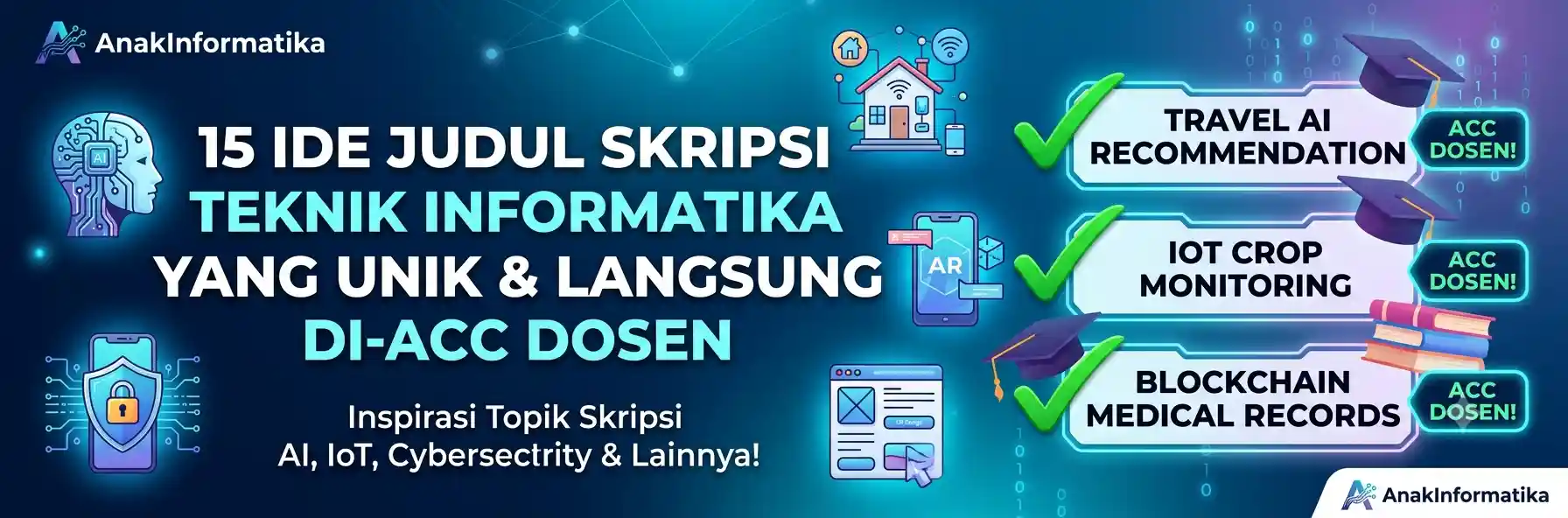
If you are feeling anxious about finding inspiration, don't worry! This article will present 15 Unique Informatics Engineering Thesis Topic Ideas Ready for Immediate Advisor Approval. We have compiled a variety of exciting topics ranging from Artificial Intelligence, Internet of Things (IoT), and Cybersecurity, to innovative application development. Let’s break them down one by one!
Why is a Unique Thesis Topic Important?
Before diving into the list, let's understand why choosing a unique and relevant topic is highly crucial:
-
Attracting Your Advisor's Interest: Thesis advisors are definitely more interested in proposals that offer something fresh and unexplored.
-
Deep Research Potential: A unique title often opens up opportunities to explore new technologies or methodologies.
-
Scientific Contribution: You can make a real contribution to the field of Informatics Engineering rather than just repeating existing research.
-
Personal Motivation: Working on a topic that you are genuinely interested in and find unique will make the thesis process much more enjoyable and less tedious.
ℹ️ Did You Know? Thesis advisors often have specific areas of expertise. Tailoring your thesis idea to align with your target advisor's interests or ongoing research can significantly boost your chances of getting approved! Do a little research on your target advisor's academic profile.
15 Unique Informatics Engineering Thesis Topic Ideas Ready for Immediate Advisor Approval
Ready to get inspired? Let's dive into these ideas:
1. Artificial Intelligence (AI) & Machine Learning (ML)
AI and ML are the crown jewels of tech today. Many complex problems can be solved using these two technologies.
-
Travel Destination Recommendation System Based on User Behavior and Social Media Sentiment Analysis.
This idea combines the analysis of user behavior patterns (e.g., search history or visited locations) with public sentiment regarding a place extracted from social media platforms (Twitter, Instagram). The goal is to provide highly personalized and dynamic recommendations.
-
Agricultural Commodity Price Prediction Using Long Short-Term Memory (LSTM) and Weather Data.
Agricultural commodity prices are highly volatile. By leveraging deep learning models like LSTM and integrating weather data (temperature, rainfall), you can build a more accurate prediction system to assist farmers and distributors.
-
Convolutional Neural Network (CNN) Based Rice Plant Disease Detection from Leaf Imagery.
Farmers often struggle to identify crop diseases at an early stage. This thesis can develop a CNN model to recognize types of diseases from photos of rice leaves, enabling faster and more accurate treatment.
-
Automated Sentiment Analysis of E-Commerce User Reviews for Feature Improvement.
There is a wealth of valuable data hidden in e-commerce user reviews. Using NLP (Natural Language Processing) and ML, you can categorize positive, negative, or neutral sentiments to provide actionable insights for developers to improve features or products.
-
Developing a Machine Learning Model for Customer Churn Rate Prediction in Streaming Services.
How do video streaming services retain their subscribers? By predicting which customers are likely to cancel their subscription (churn), companies can design the right retention strategies. You can utilize demographic data, viewing history, or user interactions.
2. Internet of Things (IoT) & Smart Systems
IoT allows devices to "talk" to one another, creating smart solutions for everyday life.
-
IoT-Based Indoor Air Quality Monitoring System with Early Notification.
Indoor air quality is frequently overlooked. This idea involves IoT sensors to monitor PM2.5, CO2, humidity, and temperature, then sends notifications or even automatically activates air purification if the quality drops.
-
Smart Automated Irrigation for Hydroponic Farming Using Soil and Weather Sensors.
Water efficiency is vital. This system will automatically regulate watering in hydroponic farming based on plant needs detected by soil moisture sensors and real-time weather data.
-
Smart Home Security System Development with Motion Detection and Facial Recognition.
Enhance home security by combining motion sensors, CCTV cameras, and facial recognition technology. The system can send alerts to a smartphone if suspicious activity or an unrecognized person is detected.
-
Implementation of RFID Technology for Automated Warehouse Inventory Management.
Manual warehouse management is highly prone to errors. With RFID (Radio-Frequency Identification), tracking incoming and outgoing goods can be done automatically, reducing processing time and inventory errors.
3. Web/Mobile Development & User Experience (UX)
Developing intuitive and functional applications is a perennial industry demand.
-
Interactive Mobile Guide Application for Historical Tourism Using Augmented Reality Technology.
Imagine visiting a historical site, pointing your phone camera, and seeing a visual reconstruction, detailed information, or even historical characters appearing on your screen! This will provide a much more immersive and educational travel experience.
-
Interactive Web Educational Platform for Learning Sign Language Using Camera Gesture Detection.
Helping the hearing impaired or anyone who wants to learn sign language. This platform can use AI (e.g., TensorFlow.js) to detect and verify user hand gestures through a webcam.
-
Digital Journaling Application Development with Gamification Features for Productivity Enhancement.
Keeping a daily journal can sometimes feel tedious. By adding gamification elements (points, levels, achievements, streaks), this app can encourage users to routinely write and self-reflect while boosting their productivity.
4. Cybersecurity
Cyber threats continue to evolve, making innovation in this field highly sought after.
-
Digital Forensics Analysis on Mobile Devices for Advanced Phishing Attack Detection.
Phishing has become highly sophisticated. This thesis can focus on developing methods or tools to analyze digital footprints on mobile devices (logs, app cache, browser history) to identify and reconstruct complex phishing attacks.
-
Implementation of Blockchain for Secure Patient Medical Record Data.
Medical data is sensitive information. With blockchain, patients' medical records can be stored and accessed with a high level of security and transparency, preventing data tampering and ensuring privacy.
5. Augmented Reality (AR) & Virtual Reality (VR)
Immersive technologies open up many new opportunities, especially in education and entertainment.
-
Virtual Reality-Based Historical Educational Game for an Immersive Learning Experience.
Learning history is often perceived as boring. With VR, students can "step into" historical events and interact with the environment or figures from the past, making the learning process much more engaging and memorable.
ℹ️ Important Tip! Don't get stuck on just one idea. Choose 2-3 topics that interest you the most, then create a brief outline for each. This will tremendously help you when discussing options with your advisor.
Criteria for a High-Potential Thesis Topic
To ensure your thesis title stands a great chance of getting approved, pay attention to the following criteria table:
| Criterion | Description | Why It Matters (For Advisors & Students) |
| Specific & Measurable | Clear scope of research, well-defined variables, and measurable results. Avoid overly broad titles. | Eases the formulation of the problem statement, research limitations, and methodology. Advisors see you have a clear direction. |
| Originality & Novelty | Offers a fresh perspective, implements cutting-edge technology, or seeks solutions to less-explored issues. | Demonstrates creativity and scientific contribution potential. Advisors are always more drawn to new things. |
| Relevance & Impact | Solves real-world problems, aligns with current industry trends, or provides a significant contribution to science/society. | Guarantees that the thesis has practical utility and isn't just theory. Advisors love high-impact research. |
| Data & Resource Availability | Considers the accessibility of the required data, tools, or resources needed for the research. | Prevents major roadblocks during implementation. Advisors will ask about this early on. |
| Personal & Advisor Interest | Matches your passion and skills, while aligning with your thesis advisor's research area. | Boosts motivation and the quality of mentorship. Advisors tend to be more supportive of topics they excel in. |
| Feasibility | Can be realistically completed within the given timeframe and available resources (e.g., a 6-month thesis period). | Advisors will evaluate whether the title is realistic for an undergraduate student to complete. |
Practical Tips to Develop Your Idea and Get Approved
Once you have picked an idea, the next step is to make it "battle-ready" for your proposal:
-
Conduct a Preliminary Study: Do some light research on your chosen topic. Look for relevant journals, scientific papers, or past theses. What methods did they use? What research gaps can you fill?
-
Summarize the Problem & Solution: Briefly explain the problem you want to solve and how your chosen technology serves as the solution. This will be your main selling point during the pitch.
-
Prepare a Brief Methodology: Even if it's not detailed yet, map out the methodology you plan to use (e.g., system development method, the ML algorithms involved, the dataset required).
-
Identify Potential Advisors: Find out which lecturers on your campus have expertise related to your thesis idea. This will greatly streamline your mentorship process.
-
Be Brave to Ask & Open to Feedback: Do not be discouraged if your advisor gives feedback or requests modifications. That is part of the process. Staying open to suggestions is key.
Conclusion
Finding an Informatics Engineering thesis topic is indeed no easy task. However, with the right inspiration and solid preparation, you can definitely find a title that is unique, relevant, and bound for immediate approval. Remember, your thesis is your opportunity to showcase your skills and passion in the IT field.
Out of the 15 ideas above, which one caught your attention the most? Or do you have another concept you would like to develop? Feel free to share your thoughts in the comments section below! Keep up the spirit, Friends of AnakInformatika, and best of luck with your thesis!