

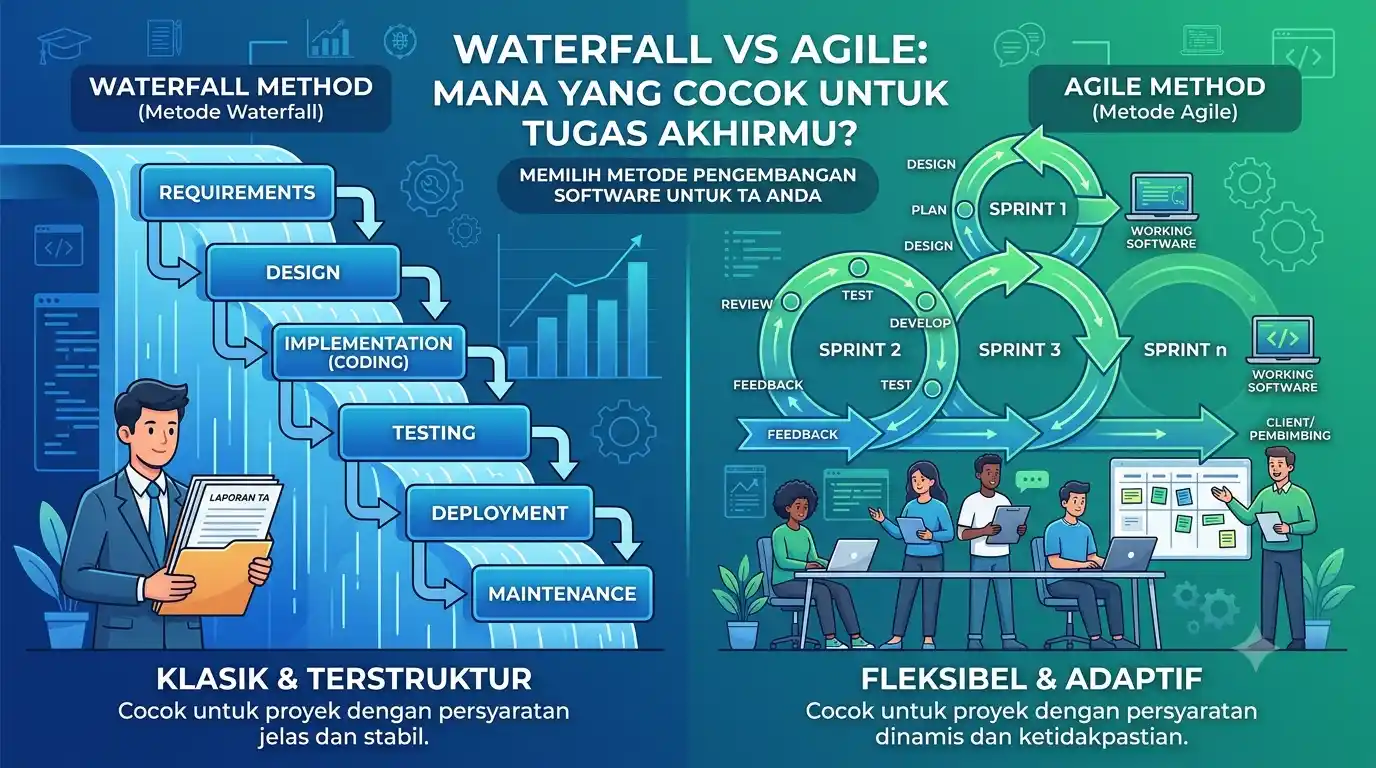
Hey there! Who here is currently getting a headache thinking about their Final Project (TA)? Pretty sure there are a lot of you! From brainstorming ideas and conducting research to coding, everything requires meticulous planning. Now, one of the most crucial decisions you need to make right at the start is determining your project development methodology. To make sure you don't take a wrong turn and your Final Project runs smoothly, let's break it down completely: Waterfall vs. Agile: Which One Suits Your Final Project?
Choosing the right methodology is like picking a vehicle for a long-distance road trip. Do you want to take a bus with a fixed route, or a personal car that can turn whenever you want? Each has its own pros and cons. The same goes for Waterfall and Agile. Both are highly popular software development methodologies, but they possess entirely different philosophies and workflows.
A Closer Look at the Waterfall Methodology: The Structured Classic
Let's start with a method that has been around for a long time and is widely taught in college: Waterfall. Imagine you are planning a long vacation to a place you have never visited before. You would definitely plan everything in detail from the very beginning, right? Starting from the destination, transportation, accommodation, daily schedule, down to the required budget. All steps are executed sequentially, one by one, and you cannot return to the previous step before the current one is finished.
Well, that is pretty much how Waterfall works. It is a linear and sequential project development methodology. This means each phase or stage of the project must be fully completed before moving on to the next one. Just like a waterfall, water only flows downward; it cannot go back up.
Key Phases in Waterfall:
-
Requirements (Requirement Analysis): Gathering and documenting all system requirements in complete detail at the very beginning of the project.
-
Design (System Design): Designing the system architecture, database, interfaces, and other components based on the defined requirements.
-
Implementation (Coding): Translating the design into program code.
-
Testing: Testing the entire system to find and fix bugs or errors.
-
Deployment: Launching the system into the production environment.
-
Maintenance: Performing fixes, updates, and enhancements after the system is live.
Pros of Waterfall:
-
Clear Structure: Each phase has specific goals and deliverables, making the project easy to monitor.
-
Strong Documentation: Due to its structured nature, documentation becomes incredibly comprehensive and detailed. This is excellent for project handovers.
-
Easy to Manage: With a plan set in stone from the start, project management becomes easier to handle, especially for inexperienced teams.
-
Predictable Cost & Time: Budget estimates and timelines can be highly accurate if the requirements are crystal clear from the get-go.
Cons of Waterfall:
-
Rigid and Hard to Adapt: This is its biggest flaw. Changing requirements midway through the project is very difficult to accommodate and can cause massive delays.
-
Delayed Feedback: Users or clients can only see the final product after all phases are completed. If there is a mismatch, fixing it will be highly expensive and time-consuming.
-
High Risk at the End: Errors or issues discovered during the testing phase or after deployment can be fatal because you might have to restart from the beginning.
-
Unsuitable for Complex Projects: Difficult to apply to projects with unclear or constantly changing requirements.
ℹ️ Did You Know? The Waterfall method is also frequently referred to as a "predictive" method because it attempts to predict everything from the start, unlike Agile, which is "adaptive."
Understanding the Agile Methodology: The Adaptive and Flexible One
Now, Agile is the exact opposite. Imagine you are planning a vacation, but you only know the main destination and a few places you want to visit. The route, accommodation, and other activities can change at any time depending on the conditions on the ground, recommendations from a new friend, or sudden promo deals. You focus more on the experience of each segment of the journey rather than a rigid itinerary.
Agile is an iterative and incremental approach to software development. This means the project is broken down into short cycles (called "sprints" in Scrum) that usually last between 1 to 4 weeks. Every sprint produces a small, functioning piece of the product that can be tested.
Core Principles of Agile:
Agile is built upon the "Agile Manifesto," which emphasizes:
-
Individuals and interactions over processes and tools.
-
Working software over comprehensive documentation.
-
Customer collaboration over contract negotiation.
-
Responding to change over following a plan.
Popular methodologies like Scrum, Kanban, and Extreme Programming (XP) are implementations of these Agile principles.
Pros of Agile:
-
High Flexibility: Highly adaptive to changing requirements. Changes can be accommodated in every sprint cycle.
-
Fast Feedback: Clients or users can provide feedback regularly at the end of each sprint, ensuring the product aligns with expectations.
-
Customer Satisfaction: High client involvement makes the product more relevant and tailored to what they actually want.
-
Risk Mitigation: Mismatches or issues can be detected early on, allowing fixes to be made before becoming major problems.
-
Quality Improvement: Continuous testing and refinement in every iteration tend to produce a higher-quality product.
Cons of Agile:
-
Documentation Can Be Lacking: Because the focus is on working software, detailed documentation is sometimes neglected (though this depends on the implementation).
-
Requires a Self-Organizing Team: Agile teams must be proactive, disciplined, and capable of managing themselves.
-
Potential for "Scope Creep": Without clear boundaries, the project can expand out of control (scope creep) if changing requests are not managed properly.
-
Difficult for Large-Scale Projects: It can be a challenge to manage multiple interdependent Agile teams.
ℹ️ Did You Know? Even though Agile emphasizes "working software over comprehensive documentation," it doesn't mean Agile doesn't need documentation at all. Documentation still exists, but it focuses more on value and essence rather than excessive formality.
A Nuanced (or Massive?) Difference Between Waterfall and Agile: A Summary Table
To help you easily compare these two methods, let's look at them side-by-side:
| Comparison Feature | Waterfall | Agile |
| Approach | Linear, sequential, structured (waterfall) | Iterative, incremental, adaptive (short cycles) |
| Flexibility to Change | Low, hard to accommodate changes after the initial phase | High, changes can be accommodated in every iteration |
| Client/User Involvement | Minimal (only at the beginning and the end of the project) | High and continuous (in every iteration) |
| Primary Focus | Following a predetermined plan and process | Delivering working software and adapting to needs |
| Documentation | Extremely comprehensive and formal | Minimalist, focusing on value and essence |
| Risk | High at the end; discovering issues late can be fatal | Distributed throughout the project; easier to manage |
| Best Suited For | Projects with clear, stable, and unchanging requirements | Projects with dynamic, complex requirements that need innovation |
Which One Suits Your Final Project? Here are the Practical Scenarios!
Alright, you should have a good overview by now, right? Now, let's tie this directly to the context of your Final Project. Choosing the right method is vital so that your project doesn't fall apart halfway through.
When is Waterfall Suitable for Your Final Project?
Choose Waterfall if your project possesses these characteristics:
-
Requirements are Highly Clear and Stable: You know exactly what needs to be built, what the features are, and how it works. Your advisor has also provided highly detailed specifications that won't change much. Examples: Implementing a well-established algorithm, creating a basic information system with standard features (e.g., a simple CRUD system), or rebuilding an existing application with minor modifications.
-
Strict Time Constraints and Scope: You have a rigid deadline and zero tolerance for scope changes. With Waterfall, you can plan every single step with precision.
-
Small-Scale and Simple Projects: For projects that aren't overly complex and carry low risk, Waterfall can be an efficient choice because its workflow is easy to follow.
-
Documentation is Paramount: If your academic advisor heavily emphasizes neat and complete documentation at every single phase, Waterfall facilitates this perfectly.
When is Agile Suitable for Your Final Project?
Choose Agile if your project looks more like this:
-
Dynamic or Unclear Requirements: You have a big idea, but the feature details or implementation might evolve. You need the flexibility to experiment or adjust based on the latest research findings. Examples: Developing an innovative mobile/web app, an AI/ML-based project that requires a lot of data experimentation, or a system involving highly interactive UI/UX that needs repeated feedback from potential users (or your advisor).
-
Opportunities for Regular Interaction with Your Advisor: If you and your advisor can meet regularly (e.g., every week or two) to demo your progress and get feedback, Agile will be incredibly effective.
-
Desire to Produce a Testable "Product" Midway: You want to have a working prototype at every stage so that it can be immediately tested and improved. This is great for demonstrating continuous progress and reducing end-stage risks.
-
More Complex Projects Requiring Exploration: For projects involving a lot of uncertainty or unexplored areas, Agile allows you to adapt and learn along the way.
ℹ️ Did You Know? Many Final Projects can actually implement a "Hybrid Approach." For instance, the requirement analysis and initial design phases are done using Waterfall, while the implementation and testing phases are conducted using Agile (iteratively). This can serve as a highly effective compromise!
Conclusion: Choose What Fits Best, Not What's Most Popular!
So, how about it? Shed some light on your decision? The bottom line is that there is no absolutely "better" method. There is only the method that best matches the characteristics of your Final Project, your team (if you are working in a group), and of course, your own working style.
It is highly important to discuss the methodology you plan to use with your advisor. Explain your reasoning and demonstrate your understanding of the pros and cons of each method. Doing this will definitely score you some major bonus points in their eyes!
Hopefully, this article helps you make the best choice for your Final Project journey. Remember, good planning is half the battle won!
Now that you’ve read this, which method do you feel fits your Final Project best? Or perhaps you have a unique experience using one of these methods? Share your stories in the comments section below!