

Welcome, aspiring digital innovators! The world of mobile app development continues to spin at the speed of light. Every year, new technologies emerge, trends shift, and framework options become increasingly diverse. For you, computer science students charting your future in the tech industry, one of the most crucial decisions is: "Which mobile development framework should I master?"
This question becomes even more relevant as we project ourselves to 2026. In the cross-platform mobile app development arena, two giants continue to dominate the conversation: Flutter vs. React Native. Both offer the sweet promise of efficiency, broad reach, and exceptional user experience. But which one is the most strategic to learn to prepare you for the challenges and opportunities of 2026? Let's dive in.
Why Framework Choice Matters for Computer Science Students in 2026?
Choosing a framework isn't just about following trends; it's an investment in your career future. By 2026, the demand for competent mobile developers will be even higher, especially for those capable of building high-quality applications across various platforms (iOS and Android) quickly and efficiently. This skill set will be a major selling point in a competitive job market.
Proficiency in cross-platform frameworks allows you to:
- Increase Efficiency: Create a single codebase for two platforms, saving time and resources.
- Accelerate Time-to-Market: Applications can be released faster, crucial for startups or innovative projects.
- Expand Market Reach: Target both iOS and Android users simultaneously.
- Broad Career Prospects: Open doors to various companies, from startups to large corporations adopting these technologies.
Therefore, understanding the differences and future potential of Flutter vs. React Native in 2026 is a smart first step for every computer science student.
A Closer Look at Flutter (2026 Projection)
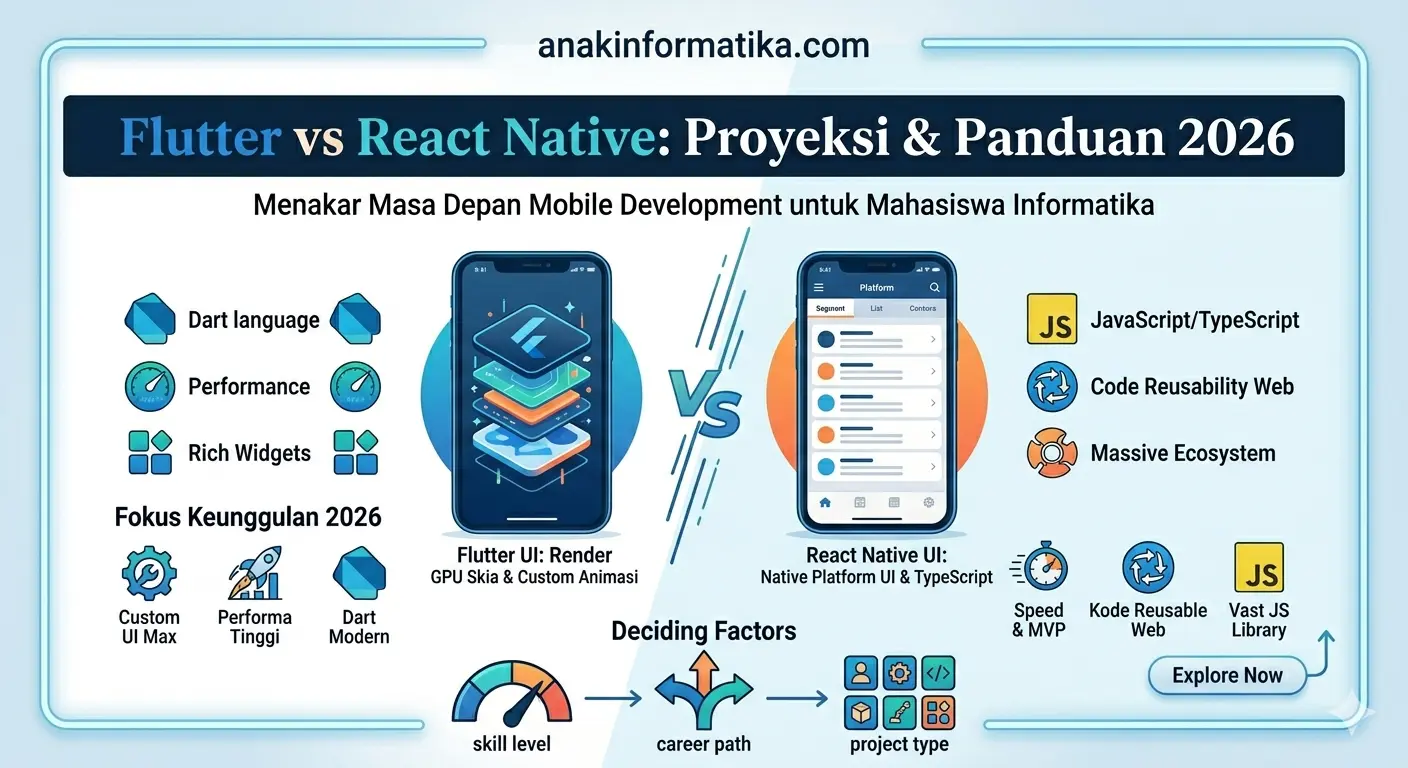
Flutter, developed by Google, has shown explosive growth since its release. With the Dart programming language, Flutter enables developers to build beautiful, high-performance user interfaces (UIs) that closely mimic native app experiences. By 2026, Flutter is expected to mature further and solidify its position as a primary choice for custom and complex UI development.
Flutter's Strengths in 2026:
- Exceptional Performance: Flutter renders UI directly to the GPU, resulting in extremely fast and smooth performance, almost identical to native applications. This will be a major draw for apps requiring high responsiveness.
- Beautiful Custom UIs: With its rich and flexible widgets, Flutter allows developers to create unique and complex UI designs without limitations. This is ideal for applications aiming for visual distinction.
- Strong Google Support: As a Google product, Flutter receives consistent development support and excellent integration with other Google technologies. Projects like Fuchsia OS also pave the way for Flutter beyond the traditional mobile ecosystem.
- High Productivity: Features like Hot Reload and Hot Restart enable developers to see code changes instantly, accelerating the development and debugging cycle.
- Rapidly Growing Community: Although newer than React Native, Flutter's community is growing very quickly, providing abundant resources, packages, and support.
Flutter's Challenges in 2026:
- Dart Learning Curve: For students unfamiliar with Dart, there's a new language to learn. However, Dart itself is relatively easy to pick up, especially if one has a foundation in C++ or Java.
- App Size: Flutter applications tend to have slightly larger file sizes compared to native or React Native apps, although Google continues to optimize them.
- Younger Ecosystem: While rapidly growing, Flutter's package and library ecosystem might not yet be as extensive as React Native's, which is bolstered by the vast JavaScript ecosystem.
Major applications built with Flutter include Google Pay, Alibaba, and BMW. This demonstrates its capability to handle large-scale projects with high-performance requirements.
A Closer Look at React Native (2026 Projection)
React Native, developed by Facebook (now Meta), leverages the power of JavaScript and React to build mobile applications. As part of the massive JavaScript ecosystem, React Native has become a popular choice for many web developers looking to transition to mobile. By 2026, React Native will remain a strong contender, especially for teams already familiar with JavaScript and seeking rapid development.
React Native's Strengths in 2026:
- Massive JavaScript Ecosystem: This is React Native's biggest advantage. Millions of JavaScript developers worldwide mean an enormous community, a wealth of libraries, tools, and available resources.
- High Code Reusability: Developers can share a significant portion of code between web (using React) and mobile applications, which is highly efficient for companies operating on both platforms.
- Fast Development Time: With Hot Reload and a rich ecosystem, React Native enables very rapid prototyping and MVP (Minimum Viable Product) development.
- Flexibility: Due to its JavaScript foundation, there are many ways to integrate native code when necessary, providing additional flexibility.
- Strong Corporate Support: Meta continues to invest in React Native's development, ensuring stability and continuous updates.
React Native's Challenges in 2026:
- Variable Performance: While its performance is excellent for many applications, React Native sometimes doesn't achieve the same level of responsiveness or animation smoothness as Flutter, especially for highly complex UIs or graphics-intensive tasks.
- Reliance on the Bridge: Communication between JavaScript and native UI elements requires a "bridge," which can sometimes be a performance bottleneck or a source of bugs.
- Ecosystem Fragmentation: With numerous third-party libraries, compatibility issues between versions or dependencies can sometimes arise.
- Complex Debugging: Debugging in React Native can be more challenging compared to Flutter, particularly when dealing with native modules.
Major applications using React Native include Facebook, Instagram, Shopify, and Tesla. This demonstrates its capability to build applications used by millions of users.
Framework Duel: Flutter vs. React Native in 2026 (In-Depth Comparison)
To help you make a decision, let's compare these two frameworks directly, considering their relevance in 2026.
Feature | Flutter (2026 Projection) | React Native (2026 Projection)Language Base | Dart. A modern, object-oriented language optimized for UI. Easy to learn for those with C++/Java backgrounds. | JavaScript (TypeScript is highly recommended). The world's largest ecosystem, very familiar to web developers.
Performance | Very high, near-native. Uses the Skia engine to render UI directly to the GPU. Ideal for complex animations. | Good, but occasionally has overhead from the JavaScript bridge. Sufficient for most apps, but may not be as smooth as Flutter for intensive graphics.
UI Development | Flexible with rich custom widgets. Builds UI from scratch with consistent aesthetics across platforms. "Pixel-perfect" control. | Uses native components. The UI feels native because it leverages platform UI components. However, deep customization can be challenging.
Community & Ecosystem | Rapidly growing and active. Strongly backed by Google. Many high-quality packages, though the ecosystem is younger. | Vast and mature. Sustained by the massive JavaScript/React community. Thousands of libraries and tools available.
Stability & Corporate Support | Strong support from Google, including the future of Fuchsia OS. High stability. | Strong support from Meta (Facebook). Relatively stable, though there are occasionally rapid API changes following JavaScript's evolution.
Learning Curve | Moderate. Learning Dart and new widget concepts. However, documentation is excellent. | Low for those familiar with JavaScript/React. Moderate for those who aren't. React concepts are quite intuitive.
Career Prospects (2026) | Demand is rising sharply, especially for startups and companies prioritizing custom UI/UX and high performance. | Demand is stable and high, especially in companies already using JavaScript or needing rapid development.
Scalability | Highly scalable, suitable for large-scale and complex applications. | Highly scalable, used by many large apps. However, dependency management can be a challenge.
Deciding Factors for Informatics Students in 2026
Choosing between Flutter vs. React Native in 2026 isn't about finding the "best" one, but the "best for you." Consider these factors:
- Background and Programming Language Interest:
- If you are comfortable with JavaScript and its ecosystem (Node.js, ReactJS), React Native will feel more familiar and allow you to be productive immediately.
- If you're interested in learning a modern new language (Dart), have a strong foundation in OOP languages like Java or C++, and love full control over UI/UX, Flutter is an exciting choice.
- Long-Term Career Goals:
- Want to work at fast-moving startups that need instant MVPs? React Native is often the go-to for development speed.
- Targeting large companies investing in unique custom UIs, maximum performance, or even IoT/Embedded development with Fuchsia OS? Flutter might be more relevant.
- Type of Projects You Want to Build:
- For apps with highly specific UIs, rich animations, and a truly unique user experience, Flutter provides unparalleled pixel-by-pixel control.
- For more standard, form-based apps or those requiring quick integration with web APIs, React Native is a highly efficient choice.
- Resource Availability and Local Community:
- Check if there are active Flutter or React Native developer communities in your city or campus. Learning from peers is a valuable asset.
Conclusion: Which One Should Informatics Students Learn in 2026?
There is no single absolute answer. Both frameworks are world-class technologies that will remain relevant and in demand through 2026 and beyond.
- Choose Flutter if you: Are interested in high performance and beautiful custom UIs; want to learn a modern, efficient language (Dart); love full control over every visual aspect; and see potential in the Google ecosystem.
- Choose React Native if you: Are already familiar and comfortable with JavaScript/React; prioritize development speed and code reusability between web and mobile; want access to the vast JavaScript ecosystem; and seek flexibility for diverse projects.
Ultimately, as an informatics student, the most important skill is the ability to learn and adapt. Start with the one that interests you most, master the core concepts, build a few projects, and then consider exploring the other. Having a fundamental understanding of both frameworks will make you an incredibly valuable asset in the 2026 job market.